Monographs
2026

Smart Charging in Solar Microgrids: Intelligent Forecasting and Control for Sustainable Electric Mobility
/ ed. by A. Zaporozhets // Springer, 2026. – 136.
The integration of microgrids with solar generation enhances energy efficiency, stability, and sustainability. Yet, managing such systems requires advanced forecasting and optimisation models. Microgrids that unite distributed sources, storage, and intelligent control enable efficient energy use even under grid constraints. Powering electric vehicle charging stations with solar energy supports eco-friendly and independent mobility.
This book explores modern methods for modelling and controlling EV charging stations within solar-powered microgrids. It focuses on predictive models, load balancing, and optimisation algorithms that improve energy distribution and grid reliability. Special attention is given to intelligent control strategies, machine learning applications, and adaptive scheduling.
The presented approaches advance sustainable energy development, enabling flexible, efficient, and environmentally friendly charging infrastructure for the electric transport of the future.

Digital Technologies in Education II: Selected Cases
eds. by O.Spirin, A. Iatsyshyn, V. Kovach, I. Semenets-Orlova, A. Zaporozhets // Springer, 2026. 377.
This book describes the theoretical aspects and practical cases that digital technologies and open science tools provide for the digital transformation of education. It also presents the results of scientific research and various surveys among students and teachers. The surveys were conducted to obtain feedback and real data on the advantages, features and disadvantages of using digital technologies in the educational process.
The book consists of three sections, each of which covers important aspects of the introduction and use of digital technologies for education management, training, and professional development of specialists in various fields. The first part is “Digital Transformations in Education: Implementing New Knowledge Management Strategies”. It discusses platforms for distance and hybrid learning, immersive technologies, open educational resources, and online encyclopaedias and considers various ways to create an accessible and high-quality educational environment in the context of digital transformation. The second part is “Unleashing Potential: Knowledge Management and Digital Technologies in Higher Education”. It presents specific cases on the use of digital technologies for higher education that are already being implemented or can be applied in Ukraine and recommendations for practical use. Third part is “Digital Technologies for Scientists’ Advanced Training”. The section is dedicated to the implementation of the concept of open science in the training of specialists in various fields, Ukraine’s integration into the global educational and scientific community and overcoming barriers to access to knowledge, and covers the issues of teacher evaluation and research assessment.
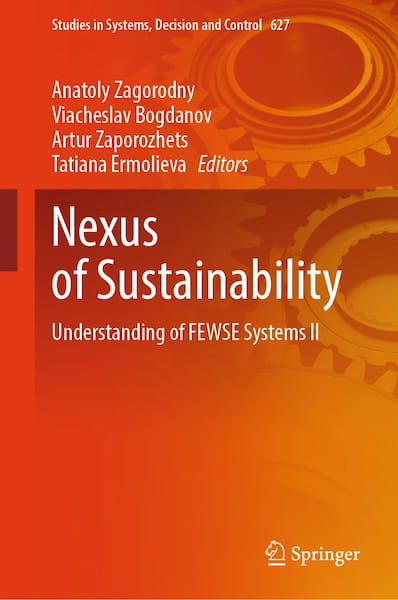
Nexus of Sustainability: Understanding of FEWSE Systems IІ
Nexus of Sustainability. Understanding of FEWSE Systems ІI // eds. by Zagorodny A., Bogdanov V., Zaporozhets A., Ermolieva T.. Springer, 2026. – 656 p.
This book emphasizes the need for harmonized policies and adaptive strategies that can address the complexities of local, national, and global systems simultaneously. The interconnected challenges of our time—climate change, resource depletion, systemic risks, and socio-economic inequalities —demand a multidisciplinary and integrated approach to sustainable development. This second volume, Nexus of Sustainability: Understanding of FEWSE Systems II, builds upon the foundations laid in the first volume, deepening our exploration of the complex interplay among Food, Energy, Water, Social, and Environmental (FEWSE) systems. It highlights both the vulnerabilities within these systems and the transformative opportunities that arise when they are considered as interconnected components of a greater whole. This book comes at a pivotal moment in global sustainability discourse. Building on the outcomes of the Joint Research Project between the National Academy of Sciences of Ukraine (NASU) and the International Institute for Applied Systems Analysis (IIASA), this book synthesizes advanced systems analysis, innovative modeling methodologies, and robust decision-making frameworks. These approaches aim to address emerging systemic risks—including those exacerbated by the COVID-19 pandemic, geopolitical instabilities, and accelerating environmental change—and to develop practical, evidence-based strategies for ensuring the resilience and security of FEWSE systems. The collaborative efforts between NASU and IIASA have been instrumental in shaping the insights presented in this volume. With contributions from leading disciplinary institutes and research groups, this work integrates knowledge from academia, industry, policy, and community stakeholders. The research spans diverse methodologies, including stochastic optimization, machine learning, downscaling techniques, distributed model linkage, and robust estimation methods.
2025
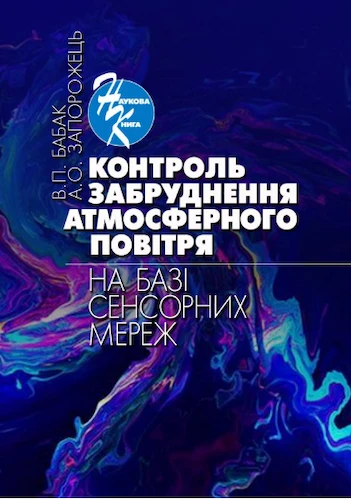
Technical Sciences: Air Pollution Control Based on Sensor Networks: Monograph
V.P. Babak, A.O. Zaporozhets / General Energy Institute of the NAS of Ukraine / – Kyiv: Akademperiodyka, 2025. – 354 p. – ISBN 978-966-360-560-9. (in Ukrainian)
The monograph considers modern problems of air pollution control based on spatially distributed wireless sensor networks and ways to solve them. The level of consumption of various types of energy resources in Ukraine and the world is analyzed and their impact on atmospheric air pollution is studied. Variants of constructive solutions of measuring modules of the air pollution control system are proposed to increase the level of information content about the state of functioning of various types of energy facilities. Promising directions of development of methodological and hardware and software support for air pollution control by energy facilities are formed.
For researchers, engineers, as well as teachers, postgraduates and students of higher educational institutions dealing with problems of pollution control from energy facilities, environmental monitoring, scientific instrument making and metrology.
This book develops a method for economic-technological forecasting of the optimal functioning and parameters of the energy system. The relevance of this work is determined by current trends and challenges in the field of energy and sustainable development, considering the following key points: 1. transition to renewable energy: Optimizing the structure of integrated energy systems with a focus on renewable energy sources and distributed generation is crucial for achieving sustainable development goals and mitigating climate change. 2. Technological progress: Continuous advancements in generation technologies, energy storage, and smart grid development provide new opportunities for the optimal integration of renewable energy into existing and new energy systems. Models and tools that can promptly track the variability and intermittency of renewable sources are essential for making optimal management decisions to ensure the reliability and resilience of energy systems. 3. Environmental impact: Optimizing energy systems using renewable sources helps reduce greenhouse gas emissions and minimize negative environmental impacts. 4. Integration of energy storage: Effective use of energy storage technologies is a key aspect of optimizing energy systems with a high share of renewable energy sources. Models that address the optimal integration of energy storage (batteries) and demand response strategies are crucial for maintaining the stability of electricity generation and supply. 5. Social significance: Research into models and means of optimizing the implementation of renewable energy can contribute to creating effective scenarios. 6. Economic competitiveness: Reducing the costs of renewable energy technologies combined with the potential savings from optimizing the operation modes of traditional generation makes the integration of renewable energy economically attractive. Thus, the task of developing new and improving existing methods and economic-mathematical models for studying the directions and optimal parameters of the technological development of energy system elements is a relevant scientific problem that needs to be addressed.
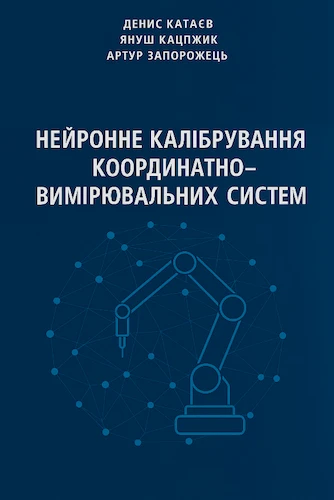
Technical Sciences: Neural Calibration of Coordinate Measuring Systems
D. Kataiev, J. Kacprzyk, A. Zaporozhets / General Energy Institute of the NAS of Ukraine / – Kyiv: PRO FORMAT, 2025. – 105 p. (in Ukrainian)
The monograph presents a comprehensive approach to the creation of adaptive information-measuring systems of a new generation, combining classical calibration methods with machine learning algorithms. A method for calibrating coordinate-measuring systems using three standards, a model for single-point compensation of residual kinematic errors, and a method for reducing the influence of non-kinematic factors based on machine learning have been developed. The architecture of a software-information complex with an integrated neural network capable of self-learning and compensation for the influence of destabilizing factors in real time has been proposed. Error simulation methods, data preparation algorithms have been developed, and 432 modifications of neural networks have been tested, which allowed determining the optimal architectures for practical application.
For researchers, engineers, teachers, and students of higher educational institutions dealing with problems of power engineering, reverse engineering, and product quality control using coordinate-measuring systems.

Noise signals: Modelling and Analyses
V. Babak, A. Zaporozhets, Yu. Kuts, M. Fryz, L. Scherbak Springer, 2025. – 222 p. – ISBN 978-3-031-71095-7 – Scopus
he book meticulously details a constructive mathematical model of a stochastic noise process, specifically a linear random process and its characteristics. Theoretical reasoning on the relationship between random processes with independent increments and those with independent values, known as random processes of white noise, is provided. The model of a linear random process serves as a mathematical representation of colored noises in various hues. Characteristics of both non-stationary and stationary linear random processes are elucidated, with emphasis on their ergodic properties, crucial for practical applications. The study also encompasses the vector linear random process, portraying a model of multi-channel noise signals. A novel contribution to the theory of random functions is the development of a constructive model of a conditional linear random process. This involves determining its distribution laws in the form of a characteristic function and relevant statistical characteristics, which can serve as potential indicators for identifying stochastic noise processes. The book revisits research on periodic stochastic models, examining cyclic, rhythmic, natural, and artificial phenomena, processes, and signals. A comprehensive analysis of the linear periodic random process is conducted, and the identification characteristics of periodic models of stochastic noise signals are explored. Significant attention is directed toward employing contour and phase methods as a theoretical foundation for addressing narrow-band noise signal identification challenges.

Statistical Diagnostics of Electric Power Equipment
V .Babak, S. Babak, A. Zaporozhets – Springer, 2025. – 427p. ISBN 978-3-031-76252-9 – Scopus
This book considers the issues of constructing mathematical probabilistic models of diagnostic signals, the development of statistical methods of their analysis in order to make diagnostic decisions and, finally, the technical implementation of the proposed diagnostic methods. Following the concept of primacy of the mathematical model of the diagnostic signal, the authors considered it expedient to consider first of all the questions connected with the theory of random processes possessing infinitely divisible distribution laws, linear and linear periodic random processes. Considerable attention is paid to the issues of simulation modeling of diagnostic signals and their statistical evaluation. Modern element base and new information technologies allowed to develop, build and practically test a number of experimental samples of information-measuring systems of statistical diagnostics of electric power engineering objects. Among these IMS, the systems are realized by means of unmanned diagnostic complexes, and also IMS of vibrodiagnostics of moving units of electric machines represents an important role. A large amount of experimental research has shown the operability and efficiency of the built IMS samples. Particular attention is paid to the selection of diagnostic spaces, formation of training sets, construction of solving rules for diagnosis and classification of EE defects. The authors do not pretend to a comprehensive consideration of the issues of EE diagnostics using statistical methods and IMS realized on their basis. At the same time, the results of researches, stated in this monograph, were a natural continuation of the subject of application of statistical methods in the field of control, monitoring and diagnostics for objects of electric power industry.

Buildings Energy Audit: Heat Loss, Air Exchange, Microclimate
A. Zaporozhets, I. Bilous, Ie. Antypov // Springer, 2025. – 135 p. Scopus
Today, the issue of energy saving and energy security is of particular relevance both locally and globally. Today, the world is facing an acute problem of saving and rational use of energy resources in order not only to reduce their consumption but also to reduce pollutant emissions. For Ukraine, the issue of energy security has become particularly acute since the beginning of Russia’s hybrid aggression. The destruction of energy infrastructure, the threat of disruption of energy supplies, and aggressive actions in the economic sphere are driving Ukraine to improve energy efficiency along the chain from production to consumption and to develop modern energy-saving technologies. According to the European Parliamentary Research Service, households are the largest energy consumers in Europe, with final energy consumption accounting for 28% of the total energy consumption of all sectors. That is why researchers are focused on implementing resource-saving activities through the use of modern energy-efficient technologies in households and buildings, in particular, to reduce transmission and infiltration heat losses. To determine the extent of heat transfer losses, it is common to measure the thermal resistance of buildings on site. These measurements are usually made by analysing the low-density heat flux. To monitor the thermal insulation characteristics of building envelopes and materials used in repair work and establish their actual values, it is extremely important to develop modern monitoring tools and appropriate methods for measuring thermal resistance as the main indicator in assessing the energy efficiency of buildings.
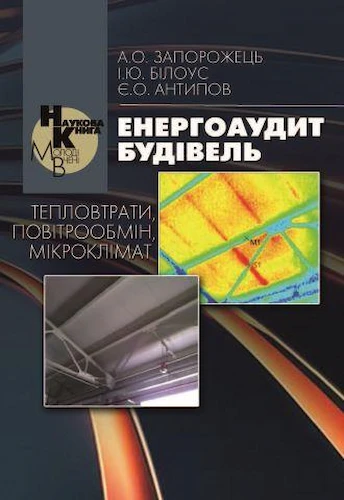
Technical Sciences: Energy Audit of Buildings: Heat Loss, Air Exchange, Microclimate
A.O. Zaporozhets, I.Yu. Bilous, Ye.O. Antypov / General Energy Institute of the NAS of Ukraine / – Kyiv: Akademperiodyka, 2025. – 182 p. (in Ukrainian)
The monograph examines the current problems of conducting an energy audit of buildings and ways to increase their energy efficiency during post-war reconstruction. The current state and regulatory requirements for the energy efficiency of buildings in Ukraine and the world are analyzed. The main informative indicators and models of energy efficiency of buildings are considered, methods for assessing the condition of their outer shell and detecting thermal failures are described. Calculation methods for determining the natural actual air exchange for multi-apartment buildings based on the improved ASHRAE methodology are proposed.
For researchers, engineers, as well as teachers, postgraduates and students of higher educational institutions dealing with the problems of increasing the energy efficiency of buildings and structures, energy management, energy audit.

Advanced Information-Measuring Technologies and Systems II
eds. Eremenko V, Zaporozhets A. // Springer, 2025. 160 p. Scopus
This book, the second volume of the book “Advanced Information-Measuring Technologies and Systems,” is a testament to the collaborative efforts of the Department of Information-Measuring Technologies of the National Technical University of Ukraine “Igor Sikorsky Kyiv Polytechnic Institute” and the General Energy Institute of the National Academy of Sciences of Ukraine. It presents the main scientific directions and issues of our joint research. The presented results of scientific research are not just solutions to classic problems of information and measurement technologies, but they also represent a leap into the future. The prediction of the metrological reliability of information and measurement systems, the features of the calibration of measuring devices and systems for measuring the parameters of electrical quantities, the development of methods for increasing the accuracy of coordinate and measurement systems and the accuracy of measuring the characteristics of harmonic signals in the time and frequency domain, the construction of software and hardware for measurement channels of systems, as well as applied tasks of information technologies—control of the fertilizer granulation process using fuzzy algorithms and chaos theory, and methods of using variable electromagnetic radiation for non-contact movement and processing of space debris, all showcase the ground breaking and exciting innovative potential of our research.

Systems, Decision and Control in Energy VII: Volume I: Power Engineering and Environmental Safety
eds. by V. Babak, A. Zaporozhets // Springer, 2025. – 841 p. Scopus
This book presents a curated selection of contemporary research, capturing the progress of Ukrainian and international scientists in addressing the complex issues surrounding energy systems, sustainable fuels, and efficient transport solutions. The world’s growing energy demands, coupled with pressing environmental concerns, present significant challenges and opportunities in the energy sector. The advancements within this sector are increasingly driven by innovations in technology, information systems, and cross-disciplinary research efforts. Through this collaborative scientific endeavor, the authors aim to offer a holistic view of current advancements and innovative solutions in three core areas: energy informatics, fuels, and transport. Energy informatics integrates data analytics, digital infrastructure, and real-time monitoring to improve energy efficiency and support sustainable energy transitions. The works presented in this section illustrate how the integration of cutting-edge computational models, artificial intelligence, and big data analytics is enabling smarter, more adaptive energy systems. Topics covered include optimization of energy consumption, predictive modeling for energy needs, and the development of robust frameworks to manage and process vast amounts of energy-related data. This section highlights how energy informatics serves as a foundational tool in meeting the evolving demands for efficient and sustainable energy.
In the fuels section, the book addresses the urgent need for alternative and cleaner energy sources. The global push toward reducing greenhouse gas emissions and mitigating climate change impacts has accelerated research into innovative fuel sources. This section underscores the critical role of novel fuel technologies in ensuring energy security and reducing environmental impact.
Transport, the third section, encompasses research on the transformation of the transport sector toward sustainability and efficiency. Transportation is a major consumer of energy and a significant source of emissions, making it a focal area in the transition to cleaner energy systems. This section presents a variety of studies on electric mobility and the development of low-emission technologies.

Maritime Systems, Transport and Logistics I: Safety and Efficiency of Operation
eds. by Melnyk O., Onishchenko O., Zaporozhets A. // Springer, 2025. – 255 p. Scopus
This book presents a comprehensive analysis of the safe operation of maritime transportation, focusing on the integration of advanced methodologies and frameworks to improve safety and efficiency. The book covers a wide range of topics, including the application of formal safety assessment (FSA), the influence of human factors in risk management, and the use of project-oriented approaches in the management of maritime operations. Synthesizing existing knowledge with innovative practices, valuable insights into safety-related problems and solutions in the maritime industry are offered, serving as an essential resource for maritime transportation professionals, researchers, and policymakers, contributing to the development of safer and more efficient maritime transportation systems.
It addresses critical aspects of maritime transportation security and offers an integrated approach that combines traditional security methodologies with advanced technologies and risk management strategies. Each chapter addresses a different aspect of maritime safety, from assessing navigational risks and human factors to implementing advanced management systems and evaluating environmental performance. The book emphasizes the importance of a holistic approach in which technical, operational, and human elements are harmoniously combined to reduce risks and improve the overall safety of maritime operations. Addressing both theoretical and practical issues, this work has the potential to make a significant contribution to the field by providing essential guidance for those involved in maritime safety, from ship operators and engineers to regulators and academic researchers. It highlights the changing landscape of maritime transportation, where safety is paramount, and the need for continuous improvement through rigorous analysis and innovative solutions.
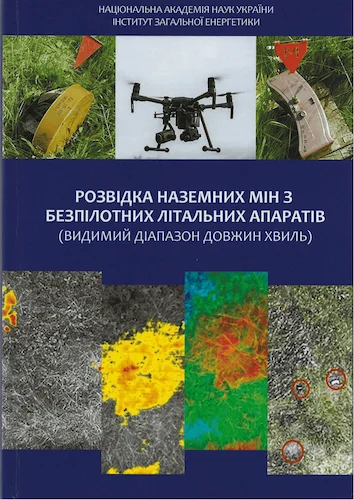
Landmine Reconnaissance from Unmanned Aerial Vehicles (Visible Wavelength Range): Collective Monograph
S.I. Kovtun, S.P. Mosov, O.O. Nazarenko, V.R. Neroba, O.V. Sieliukov, S.A. Stankevych, T.D. Chubina; ed. by Academician of the NAS of Ukraine V.P. Babak. Kyiv: Vinichenko Publishing House, 2025. – 288 p. (in Ukrainian)
The monograph reveals the historical aspects of the creation and application of mine weapons, defining their role in modern wars and border conflicts; the state of the global demining problem; the classification of landmines as objects of reconnaissance using multirotor unmanned aerial vehicle reconnaissance equipment (visible wavelength range); the construction of mine signature models; the formulation of requirements for landmine reconnaissance equipment (visible wavelength range) and the analysis of tactical and technical characteristics of modern imaging equipment for landmine reconnaissance from unmanned aerial vehicles; methodical approaches to detecting landmines using digital aerial photographs, etc.
The work was prepared by a team of authors consisting of: Doctor of Technical Sciences, Senior Researcher S.I. Kovtun; Honored Scientist and Technician of Ukraine, Laureate of the State Prize of Ukraine in Science and Technology, Doctor of Military Sciences, Professor S.P. Mosov; Candidate of Technical Sciences O.O. Nazarenko; Candidate of Military Sciences, Associate Professor V.R. Neroba; Laureate of the State Prize of Ukraine in Science and Technology, Doctor of Technical Sciences, Professor O.V. Sieliukov; Laureate of the State Prize of Ukraine in Science and Technology, Doctor of Technical Sciences, Professor S.A. Stankevych; Honored Worker of Education of Ukraine, Doctor of Historical Sciences, Professor T.D. Chubina. The seventh chapter was co-authored with Ye.Yu. Saprykin.
The text of the monograph was prepared using materials open for research, as well as the experience of foreign countries and Ukraine.
The monograph is available for review in the Institute’s library.
MONOGRAPH STRUCTURE
The monograph consists of eight chapters, lists of references for each chapter, appendices, and a glossary.
The first chapter reveals the facts of world history regarding the origin of mine weapons and the conduct of underground mine warfare; highlights the peculiarities of the emergence of the first landmines utilizing explosion energy; outlines the impact of 19th-century discoveries and inventions on the development of mine weapons; defines trends and the state of mine weapon development at the beginning of the 20th century; and discloses historical aspects of mine weapon application during World War II, as well as the specific features of engineering ammunition development after World War II.
The second chapter examines the impact of mine weapons on the course of combat operations; explores the role of mine weapons in modern wars using the example of military conflicts from the late 20th century to the first quarter of the 21st century: the Yugoslav Wars; the wars in Iraq; the Chechen military campaigns; the Arab-Israeli wars; combat operations in Syria; the Russo-Ukrainian War (note: for the period of the monograph’s preparation), as well as in border conflicts.
The third chapter covers issues related to research on the current state of the global demining problem, as well as modern approaches to its solution.
The fourth chapter investigates the characteristics of landmines used in modern warfare; defines the recognition signatures of landmines and proposes a classification of landmines as objects of reconnaissance using UAV imaging reconnaissance equipment (visible wavelength range); identifies the recognition features of landmines on digital aerial photographs; and suggests a methodology for constructing landmine signature models.
The fifth chapter outlines the development of a methodical framework for formulating requirements for UAV imaging reconnaissance equipment regarding landmine detection; defines performance indicators for UAV imaging reconnaissance equipment, along with the conditions and factors affecting its operation; and substantiates the principles and methodology for establishing requirements for UAV imaging reconnaissance equipment.
The sixth chapter examines the characteristics of modern UAV imaging equipment for landmine reconnaissance; determines the features and analyzes the operational spectral range of optoelectronic devices; and investigates visible-range reconnaissance equipment, dual visible and infrared cameras, infrared reconnaissance equipment, as well as multispectral and hyperspectral landmine reconnaissance equipment.
The seventh chapter proposes a classification of landmine recognition signatures; reveals methodical approaches to detecting landmines on digital aerial photographs by direct and indirect features using multispectral and infrared cameras, as well as parametric data from magnetometric sensors; and provides methodical approaches to detecting landmines based on the use of convolutional neural networks and the data fusion method.
The eighth chapter contains recommendations for selecting and ensuring the operation of UAVs for landmine reconnaissance; substantiates the principles for formulating tactical and technical requirements for unmanned aircraft systems (UAS) and a methodical approach to choosing the best option, alongside recommendations for organizing the flight and technical operation of UAS.
The conclusion systematizes the role and place of unmanned aviation in landmine detection.
The appendices provide a classification of mines, data on Russian mines used in the Russo-Ukrainian armed conflict, and certain indirect recognition signatures of mine-laying.
Modern Technologies in Energy and Transport II
eds. Boichenko S., Zaporozhets A., Shkilniuk I., Yakovlieva A. // Springer, 2025. 338 p. Scopus
This book selectively defines the current state of technological development of the Ukrainian economy and the prospects for the deployment of energy-efficient technologies in the energy and transport spheres, in particular, in aviation. On the path of its socio-economic development, Ukraine has repeatedly passed through crisis moments that changed the scenarios and trends of the country’s development. Today, Ukraine has to evaluate survival scenarios and, in extreme conditions, revise plans for the country’s further development. The energy sector in Ukraine and the world exists in a dynamic environment and changes in response to internal and external challenges. Technological solutions for deploying the transition to clean renewable energy sources are already widely available in today’s world and continue to develop rapidly. In Ukraine, the problem of energy transition is given special urgency and acuteness by the threat to energy security. The state of Ukraine’s traditional energy industry determines the need to reach a modern technological level with the use of innovative renewable technologies for energy production. Increasing the level of domestic energy efficiency will contribute to the diversification of energy supply of central and distributed energy generating systems, which will ensure the creation of a low-carbon national economy and increase the role of domestic energy in the system of international cooperation, including access to international markets of energy goods and services.
The book is composed of 16 chapters in total. All chapters presented by the authors (co-authors) are published in the author’s edition and aim to present an issue on how to achieve more sustainable and more environmentally safe development of the modern transport and energy sector. The contributions of the authors and reviewers in the preparation of this book are sincerely appreciated.
Systems, Decision and Control in Energy VII: Volume II: Energy Informatics and Transport
eds. by V. Babak, A. Zaporozhets // Springer, 2025. – 383 p. Scopus
This book explores the intricate interplay between burgeoning energy demands and the imperatives of ecological sustainability. The first section, Electric Power Engineering, explores critical innovations in the generation, transmission, and distribution of electric power. As global energy demands rise, the development of efficient and reliable electric power systems becomes essential. This section includes studies on optimizing grid performance, enhancing resilience, and integrating smart grid technologies. Advances in grid automation, energy storage, and demand response are examined, reflecting the shift toward adaptive, efficient, and secure power systems.
The second section, Heat Power Engineering, addresses innovations in the generation and distribution of thermal energy. Heat power plays a vital role in industrial processes, residential heating, and energy-intensive applications, particularly in regions with cold climates. Researchers in this section present work on the optimization of heat transfer systems, combined heat and power (CHP) technologies, and efficient thermal energy storage solutions.
The third section, Renewable Power Engineering, focuses on the development and integration of sustainable energy sources. Renewable energy technologies, such as wind, solar, hydro, and biomass, have become critical in reducing carbon emissions and achieving energy independence. The contributions in this section highlight advances in renewable energy production, storage, and integration with existing power systems.
The final section, Environmental Safety, encompasses research on mitigating the environmental impact of energy production and consumption. With energy systems being one of the primary sources of emissions and pollution, environmental safety has become a central concern in energy research. This section presents studies on emission reduction technologies, pollution control strategies, and sustainable waste management practices within the energy sector. It includes research on air and water quality and sustainable resource utilization, highlighting how environmental safety measures can be incorporated into all stages of energy production and distribution.

Structure Optimization of Power Systems with Renewable Energy Sources
A. Zaporozhets, M. Kulyk, V. Babak, V. Denysov // Springer, 2025. – 146 p. Scopus
This book develops a method for economic-technological forecasting of the optimal functioning and parameters of the energy system. The relevance of this work is determined by current trends and challenges in the field of energy and sustainable development, considering the following key points: 1. transition to renewable energy: Optimizing the structure of integrated energy systems with a focus on renewable energy sources and distributed generation is crucial for achieving sustainable development goals and mitigating climate change. 2. Technological progress: Continuous advancements in generation technologies, energy storage, and smart grid development provide new opportunities for the optimal integration of renewable energy into existing and new energy systems. Models and tools that can promptly track the variability and intermittency of renewable sources are essential for making optimal management decisions to ensure the reliability and resilience of energy systems. 3. Environmental impact: Optimizing energy systems using renewable sources helps reduce greenhouse gas emissions and minimize negative environmental impacts. 4. Integration of energy storage: Effective use of energy storage technologies is a key aspect of optimizing energy systems with a high share of renewable energy sources. Models that address the optimal integration of energy storage (batteries) and demand response strategies are crucial for maintaining the stability of electricity generation and supply. 5. Social significance: Research into models and means of optimizing the implementation of renewable energy can contribute to creating effective scenarios. 6. Economic competitiveness: Reducing the costs of renewable energy technologies combined with the potential savings from optimizing the operation modes of traditional generation makes the integration of renewable energy economically attractive. Thus, the task of developing new and improving existing methods and economic-mathematical models for studying the directions and optimal parameters of the technological development of energy system elements is a relevant scientific problem that needs to be addressed.

Advanced System Development Technologies II
eds. by M. Bezuglyi, N. Bouraou, V. Mykytenko, G. Tymchyk, A. Zaporozhets // Springer, 2025. 465 p.
This book is the second in the series Advanced System Development Technologies: Studies in Systems, Decision and Control. As in the previous volume, the sections of the book are grouped into three directions: optoelectronic technologies, medical technologies, and technological support.
The prerequisites for solving the problem of increasing the efficiency of mechanical assembly production are presented, based on the creation of a new method and system for technological preparation of small-scale production in instrument engineering, which takes into account the dominant influence of assembly processes on the time and cost of instrument manufacturing. A new structure and sequence for the technological preparation of instrument production with a formalized relationship between machining and assembly production are proposed. A new model of an assembled product in instrument engineering has been developed, taking into account the labor intensity and specifics of assembly, adjustment, and control-measurement operations, as well as methods for automated design of technological assembly processes. Additionally, a functional model for forming the product structure based on the labor intensity of manufacturing assembly units is proposed, allowing for the formulation of a substantiated plan for the production of parts. A mathematical model of the assembly sequence has also been developed, enabling the construction of an assembly sequence considering organizational and technical factors.

Information-Measuring Systems. Theory and Application
V. Babak, S. Babak, V. Eremenko, Yu. Kuts, A. Zaporozhets // Springer, 2025. 496 p. Scopus
This book concentrates on virtual IMS with the use of modern information and measurement modeling technologies. Modern IMS can be implemented as: real hardware and software measuring tools; virtual IMS with the use of modern information and measurement modeling technologies, including simulation, mathematical, physical, with extensive use of computer equipment for conducting a simulation measurement experiment. Compared to real ones, virtual IMS has a number of advantages, and their implementation requires less time, production, and financial costs. However, in a number of cases, due to the information uncertainty of the object of measurement, such IMS cannot provide objective and reliable results, and therefore, it is necessary to conduct a full-scale measurement experiment using real systems. The potential capabilities of modern systems at the stage of information development of society have increased significantly, which contributes both to the expansion of the subject areas of their application and their use to increase the efficiency of known and solve new scientific and applied measurement tasks. The authors are in solidarity with other colleagues—specialists in measurements—in the forecasts of the development of IMS. No improvements in measurement information technologies, including computer and intellectual ones, have not led, are not leading, and obviously cannot lead in future to the expansion of the nomenclature of measurements of quantities while there are no corresponding sensors that form primary information during their direct interaction with the research object. Further development of IMS and their use in various fields of science and technology, including quantum metrology and nanotechnology, will largely be determined by the development of new principles of operation and the creation of new types of sensors based on them.
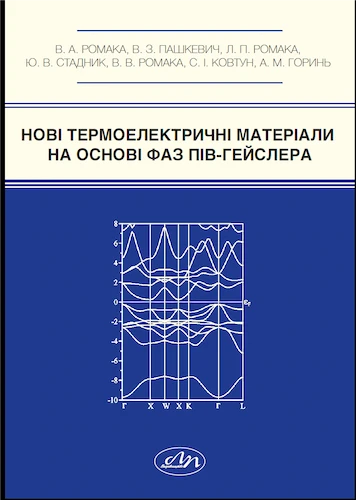
New Thermoelectric Materials Based on Half-Heusler Phases
V. Romaka, V. Pashkevych, L. Romaka, Yu. Stadnyk, V. Romaka, S. Kovtun, A. Horyn. Lviv Polytechnic Publishing House, 2025. – 628 p. – ISBN 978-966-944-086-5. (in Ukrainian)
The monograph presents the research results on a new class of thermoelectric materials with a high efficiency of converting thermal energy into electrical energy. These materials were obtained by doping the semiconductor half-Heusler phases TiNiSn, ZrNiSn, HfNiSn, TiCoSb, VFeSb, ZrCoSb, and RNiSb (R – rare-earth metal) with acceptor and/or donor impurities, which allows for controlling the Fermi level position, thereby altering the values of electrical resistivity, thermopower (Seebeck) coefficients, and thermal conductivity. The investigation of the structural, thermodynamic, electrokinetic, energetic, and magnetic properties of the thermoelectric materials made it possible to establish the peculiarities of transformations in their crystal and electronic structures, as well as the mechanisms of electrical conductivity. Physical principles for optimizing the properties of half-Heusler phases have been formulated and implemented to achieve the maximum values of thermoelectric figure of merit. In particular, an algorithm was developed to control the properties of thermoelectric materials by modeling them using KKR methods (AkaiKKR package for the MJW potential) and FLAPW within the density functional theory DFT (Vienna Ab initio Simulation Package VASP v. 5.4.4), with cyclic adjustment of the initial calculation conditions using parameters from experimental measurements.
For researchers, postgraduate students, and students specializing in metrology and information-measuring technology, materials science, micro- and nanosystem technology, applied physics, and nanomaterials.
2024

Detection of Corona Discharge in Electric Networks
Editors: Sokol Y., Babak V., Zaporozhets A., Gryb O., Karpaliuk I. Studies in Systems, Decision and Control (SSDC, volume 509), 2024. 226 p.
The book is devoted to the solution of the problem of determining the presence of corona discharge on electrical equipment with acoustic radiation. It is shown that corona discharge leads not only to irreversible losses of electrical energy, but also interferes with the transmission of high-frequency signals, deteriorates insulating elements, can become a source of conditions for the occurrence of a destructive arc discharge and is one of the factors of changing the continuity of the electrical system as a whole. The book describes the processes in a corona discharge that lead to the occurrence of acoustic waves. The authors analyzed acoustic radiation from a corona discharge reproduced in laboratory conditions. The received acoustic signals were processed by Fourier transform. Thus, the features of the spectral function, which belong specifically to the corona discharge in electrical networks with industrial frequency current, were determined. Based on the inverse Fourier transform, a simplified model of the acoustic radiation of the corona discharge was constructed. The authors proposed a method for detecting the presence of a corona discharge based on the spectral characteristics of acoustic radiation. Techniques were developed to determine the presence of a corona discharge for the creation of stationary and mobile devices. The advantages of the method of detecting the presence of corona discharge by the acoustic spectrum are shown. The method makes it possible to determine the presence of a corona discharge remotely, even out of direct sight, regardless of the time of day and regardless of the season. The book states that determining the presence of a corona discharge is not enough, it is still necessary to determine its location. The method of finding the coordinates of the corona discharge as a source of sound was described. Methods of searching for corona discharge coordinates with a fixed scanning device and a moving scanning device are proposed. A UAV is proposed as a mobile platform for the scanning system. The influence of the Doppler effect on acoustic measurements when the UAV speed changes was taken into account. The authors have shown that the use of coronal discharge detection with UAVs will not only enable the prevention of coronal discharge, but also increase the frequency of surface inspections. This will allow timely measures to be taken to improve the reliability of the power system operation. The book is intended for the researchers, postgraduate students and students specialized in theory and calculations of electrical systems.
Power Systems Research and Operation: Selected Problems III
eds. by O. Kyrylenko, S. Denysiuk, R. Strzelecki, I. Blinov, Ie. Zaitsev, A. Zaporozhets // Springer, 2024. – 371 p.
This book covers new technologies and methods related to models for short-term forecasting of electricity imbalances in the IPS of Ukraine, taking into account the impact of forecasts of energy production from renewable sources on the accuracy of the imbalance forecast. The book proposed architecture and mathematical model of an artificial neural network for deep learning forecasting of short-term electricity imbalances using hourly data. Using a model to aggregate data with an hourly resolution followed by forecasting to reduce forecast error, the quasi-dynamic modeling method was used to analyze the impact of periodic generation on the network. The application of quasi-dynamic modeling also allows taking into account the system load curve, generation profile, storage system, as well as renewable energy sources (RES) operation in this area. The use of models makes it possible to achieve realistic estimates of generation for the required period. The book considers a local hybrid renewable energy system (HRES) based on different types of RES, which is more efficient than a system with one type of source.

Modern Technologies in Energy and Transport
eds. by S. Boichenko, A. Zaporozhets, A. Yakovlieva, I. Shkilniuk // Springer, 2024. – 306 p.
The book is composed of 15 chapters in total. All chapters presented by the authors (co-authors) are published in the author’s edition and aim to present an issue on how to achieve more sustainable and more environmentally safe development of modern transport and energy sector. The chapters are grouped into 3 parts. The first part “Decisions for alternative energy sources use in modern transport” represents novel solutions in alternative energy sources development and implementation in different spheres of the modern transport sector. The second part “Solutions for reducing negative impact of energy and transport on environment” is devoted to advances in technologies aimed on reducing impact of energy and transport sectors on environment and utilization of waste. The third part of the book “Advance in alternative motor fuels technology” represents recent developments in chemical technology of alternative fuels production and aspects of modern fuels quality control.

Interactions Between Electromagnetic Field and Moving Conducting Strip
I. Kondratenko, Yu. Vasetsky, A. Zaporozhets // Springer, 2024. – 119 p.
The book combines two interrelated lines of research. One of them is devoted to the development of the theory for solving a certain class of three-dimensional electromagnetic field problems of the three-dimensional electromagnetic field, taking into account eddy currents in a moving conducting magnetizing body. Preference is given to the development of the analytical solution methods of the three-dimensional quasi-stationary problem of field conjugation in the system: “a contour of an arbitrary spatial configuration with an alternating current is conducting body with a flat boundary surface”. The second direction refers to the development of mathematical models for solving applied problems, which involve the use of developed methods for calculating the electromagnetic field and their characteristics. The main application of calculation methods is aimed at solving problems of heat treatment non-ferrous and ferrous metal products using the induction method of heating in a transverse magnetic field. The inverse problems are solved to determine the inductor configuration as flat and spatial current contours for providing the necessary temperature distribution of moving metal strips. To achieve uniform heating of strips across the width using inductors in the form of flat current contours parallel to the strip surface, it is advisable to use combinations of current contours, where the geometric dimensions are determined by the size and electro-physical parameters of the metal strips. A more uniform temperature distribution during high-frequency induction heating is achieved by using inductors in the form of current contours of the required spatial configuration.
The book is intended for researchers, postgraduate students, and students specialized in theory and calculations of electromagnetic fields and induction heating installations.

Digital Technologies in Education: Selected Cases
eds. R. Shchokin, A. Iatsyshyn, V. Kovach, A. Zaporozhets // Springer, 2024. – 230 p.
Among the technologies that significantly change the modern world of human existence, it is worth mentioning, first of all, digital technologies. These technologies are actively and relentlessly implemented and integrated into all spheres of human activity and society, becoming a powerful catalyst and a determining source of social development. According to such a scenario of development, society acquires the features of digital, thus defining digital technologies as its leading technology. This process is called the digital transformation of society. The wide use of digital technologies to provide free access to information and knowledge is a basic principle of the digital society. Digital society significantly changes traditional ideas about work, education, culture, communication, social and political life. The development of citizens’ digital culture is the main condition for the successful construction of a digital society. Therefore, it is important to carry out scientific research and targeted training to improve the qualifications of specialists in various branches of the economy, in particular, educators and scientists to acquire digital competence. After all, these specialists are key figures in ensuring the process of digitalization of education and science. The book presents various aspects of the digital transformation of education and science. A comprehensive view of the current state and prospects of the use of digital technologies for education and science is provided. The experience of using digital technologies and tools for training and improving the qualifications of specialists of various specialties, as well as for the preparation of future PhDs, is described. The book is addressed to education workers, managers, scientists, graduate students, librarians, and all those who are interested in the process of digital transformation of education and science.
Systems, Decision and Control in Energy VI, Volume I: Energy Informatics and Transport
In: Babak, V., Zaporozhets, A. (eds) / Studies in Systems, Decision and Control, vol. 561, Springer Cham. – 2024. – 534 p.
In an era marked by escalating energy demands and imperatives of environmental stewardship, this compendium serves as a comprehensive exploration of the multifaceted dimensions shaping contemporary energy development, with a focal lens on the symbiotic relationship between energy, information, and transportation systems. The canvas of 2023’s energy evolution is painted against the backdrop of heightened consciousness surrounding climate change and environmental degradation. This epoch witnesses an unyielding momentum toward sustainability, catalyzed by a profound shift in energy-sourcing paradigms. Renewable energy sources—solar, wind, hydro, and beyond—attain unprecedented prominence, not merely as alternative energy options but as linchpins of a redefined energy matrix, fostered by advancements in technology, economics, and scalability. At the nexus of this transformative energy landscape lies the realm of Energy Informatics—a domain where information technologies converge with energy systems. Smart grids, IoT-enabled devices, data analytics, and artificial intelligence orchestrate a symphony of efficiency and optimization, revolutionizing energy management, demand-response dynamics, and grid resilience. The fusion of information technology and energy infrastructures stands poised to usher in an era of unprecedented interconnectivity and adaptability. Transportation, an indispensable facet of the energy ecosystem, undergoes a metamorphosis in 2023. Electrification, hydrogen-powered vehicles, and advancements in sustainable fuels reimagine mobility paradigms, heralding a transition toward greener, more efficient transportation systems. The synergy between energy and transportation, facilitated by data-driven insights and technological innovations, propels the convergence of these domains toward a more sustainable future. Moreover, the global socio-political landscape assumes paramount significance in shaping the contours of energy dynamics. Geopolitical considerations, international collaborations, and policy frameworks delineate the trajectory of energy infrastructure investments, trade patterns, and the realization of sustainable energy transitions on a global scale. Yet, within the narrative of progress, challenges persist. Legacy infrastructures, regulatory complexities, socio-economic disparities, and the imperative of inclusive transitions underscore the complexities inherent in reshaping the energy and transportation landscapes.
Systems, Decision and Control in Energy VI, Volume II: Power Engineering and Environmental Safety
In: Babak, V., Zaporozhets, A. (eds) / Studies in Systems, Decision and Control, vol. 552, Springer Cham. – 2024. – 628 p.
This book presents the defining hallmark of 2023’s energy panorama which lies in the resounding impetus toward sustainability—a seismic paradigm shift echoing across industries, policies, and societal aspirations. Heightened awareness of climate change, environmental degradation, and the imperatives of decarbonization propel an unprecedented surge toward renewable energy alternatives. Solar, wind, hydro, geothermal, and other sustainable modalities witness not only technological advancements but a transformative surge in accessibility, affordability, and scalability, redefining the global energy matrix. Within this transformative landscape, innovation emerges as the fulcrum catalyzing the metamorphosis of energy systems. Breakthroughs in energy storage technologies, smart grid optimization, and decentralized energy solutions orchestrate a symphony of efficiency, enabling the seamless integration of intermittent renewable sources while ensuring grid stability and resilience. The amalgamation of artificial intelligence, big data analytics, and energy systems heralds a new frontier of smart, adaptive energy networks, revolutionizing the paradigm of energy consumption and management. Furthermore, the geopolitical milieu assumes heightened significance in shaping the contours of global energy dynamics. Interwoven with alliances, trade dynamics, and international agreements, geopolitics exerts profound influences on energy security, infrastructural investments, and the trajectory of sustainable energy transitions. Collaborative endeavors and multilateral initiatives reverberate as essential instruments in navigating the complexities of a globally interconnected energy landscape. However, amid the triumphant strides toward a sustainable energy future, challenges persist. The intricacies of phasing out legacy infrastructures, addressing socio-economic disparities, navigating policy ambiguities, and fostering inclusive energy transitions underscore the labyrinthine complexities that necessitate astute navigation and multifaceted solutions.

Nexus of Sustainability: Understanding of FEWSE Systems
eds. Anatoly Zagorodny, Viacheslav Bogdanov, Artur Zaporozhets // Springer, 2024. – 356 p.
The intricate interplay between food, energy, water, societal dynamics, and the environment constitutes the bedrock of contemporary global challenges. In recent decades, this convergence has emerged as a focal point for scientific inquiry, policy formulation, and societal discourse. This book seeks to meticulously unravel the complexities inherent in this nexus, shedding profound light on the interconnected risks, vulnerabilities, and transformative opportunities that define our quest for sustainability in the twenty-first century. The materials of this book were prepared mainly by authors working on the joint project between the International Institute for Applied Systems Analysis (IIASA) and the National Academy of Sciences (NAS) of Ukraine “Integrated robust modeling and management of food-energy-water-land use nexus for sustainable development”, and on the project “Comprehensive analysis of robust preventive and adaptive measures of food, energy, water, and social management in the context of systemic risks and consequences of COVID-19” (0122U000552) of the NAS of Ukraine. Members of the System Analysis Committee of the NAS of Ukraine were also involved in the preparation of book chapters. The authors dedicate this book to the memory of the Academician of NAS of Ukraine, Professor Yuri Ermoliev, who died in October 2022 and made a fundamental contribution to stochastic optimization as a basic tool for quantitative risk management. This book largely follows his ideas about risk management and its applications.

Advanced System Development Technologies I
eds. by M. Bezuglyi, N. Bouraou, V. Mykytenko, G. Tymchyk, A. Zaporozhets // Springer, 2024. – 413 p.
This book covers vibroacoustic monitoring, inertial attitude systems, and control system for device processing in complex objects. Modern approaches to the synthesis of algorithmic support for a strapdown inertial attitude system are considered. The general characteristics of navigation systems and the composition of their inertial measurement unit are given. The methods of initial alignment of the system on a stationary base are described. Particular attention is paid to the attitude kinematic parameters of the body frame and methods of their numerical integration. Picard’s methods for integrating the Bortz and Poisson kinematic equations are shown. An algorithm for a strapdown inertial attitude system based on using real signals of high-precision laser gyroscopes is proposed. System simulation was carried out using the proposed algorithmic methods.
The relevance of the control system created for the processing device parts in the conditions of automated manufacturing is substantiated. Theoretical studies are presented, and the relation between electrical signals, the level of tool wear, and the main reasons for generating electrical signals are identified. A mathematical model of cutting tool wear control was developed based on measuring the variable component of cutting electromotive force. A control system for processing device parts on computer numerical control machines in automated production conditions has been developed. It allows for recording critical wear and breakage of the cutting tool, performing its dimensional adjustment directly on the device, and carrying out its industrial approval in flexible production systems.

Advanced Information-Measuring Technologies and Systems I
Ed. by Eremenko V., Zaporozhets A. // Springer Cham, 2024. – 277 p. Hardcover ISBN 978-3-031-40717-8. eBook Scopus
The book presents the main scientific directions and issues of research conducted in the Department of Information and Measurement Technologies at the National Technical University of Ukraine “Ihor Sikorskyi Kyiv Polytechnic Institute”. The presented results cover almost all scientific directions related to information and measurement technologies—metrological support of measurement channels of information and measurement systems, methods of reproducing units of electric circuit parameters, development of specialized information and measurement systems, mathematical methods of processing measurement information, models of formation of information signals and fields, statistical diagnostic methods, information support of testing, and calibration laboratories.

Geomining. Systems and Decision-Oriented Perspective
Ed. Azer Shukurov, Oksana Vovk, Artur Zaporozhets, Natalia Zuievska. (2024). Springer Cham, Switzerland. – 297 р. Scopus
This book represents a comprehensive exploration of the intricate intersection between geology and mining through the lens of system-oriented perspectives. Geomining stands at the forefront of modern resource extraction, blending the principles of geology, engineering, transport, and environmental science to optimize the extraction of minerals and other valuable resources from the Earth’s crust. It is a dynamic field that continually evolves in response to technological advancements, environmental concerns, and economic realities. In this book, we aim to capture the essence of geomining as a holistic system, emphasizing the interconnectedness of its various components and the importance of integrated approaches to resource management. The geomining is a complex of heavy industry sectors that includes the exploration of mineral deposits, the extraction of minerals from the Earth’s subsurface, and the enrichment of valuable minerals. Among the main groups of the geomining industry, the following are distinguished—fuel extraction (coal, oil, shale, peat, natural gas extraction); ore mining (iron ore, manganese ore, extraction of non-ferrous ores, precious and rare metals, etc.); mining and chemical industry (extraction of potassium salts, rock salt, apatites, nephelines, bauxites, sulfur, phosphorites, etc.); extraction of mineral raw materials for the construction industry; extraction of mineral raw materials for refractory and ceramic industries; hydromeliorative activities. The concept of a system-oriented view on geomining recognizes that mining activities do not occur in isolation but are part of larger, interconnected systems that encompass geological, environmental, social, and economic dimensions. By adopting a systems perspective, we can better understand the complexities inherent in resource extraction and develop more sustainable and efficient mining practices.
This book is divided into 3 parts, each focusing on different aspects of geomining from a systems perspective.

Electromagnetic Field Near Conducting Half-Space: Theory and Application Potentials
Yu. Vasetsky, A. Zaporozhets // Springer, 2024. – 124 p. Scopus
The book is devoted to the solution of one general problem of the theory of a three-dimensional quasi-stationary sinusoidal and pulse electromagnetic field. These studies, unlike many well-known works, are based on obtained exact analytical solution of the problem for the field, generated by external current sources near the conducting body with plane surface. The solution for the vector and scalar potentials, electric and magnetic intensities in the dielectric and conducting media is found without restrictions on the configuration of current sources, properties of the media and field frequency. Some general properties of field formation for arbitrary field in the considered system are obtained (in particular, full compensation by the field of the electric charge distributed on the interface between the media, the normal component of the induced external electric field and, accordingly, the equality to zero the components both of the current density and the electric field intensity perpendicular to the interface; the non-uniform electromagnetic field decreases in depth of conducting medium faster than uniform field). It is shown that the exact analytical solution depends on the values of the parameter proportional to the ratio of the field penetration depth to the distance between the external field sources and the body. The concept of strong skin effect is extended to the case of small value of the introduced parameter. A significant simplification of the expressions was obtained as an asymptotic expansion on this small parameter. In the case of pulsed fields approximate method gives the highest accuracy during important initial period of pulse time. For asymptotic expansion the approximate impedance boundary condition is generalized to the diffusion of non-uniform field into conducting medium. The book is intended for the researchers, postgraduate students and students specialized in theory and calculations of electromagnetic fields.
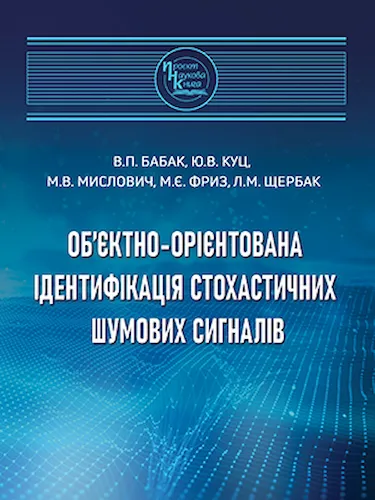
Object-Oriented Identification of Stochastic Noise Signals
V. Babak, Yu. Kuts, M. Myslovych, M. Fryz, L. Shcherbak. Object-oriented identification of stochastic noise signals. Ed. by Corr. Memb. of the NAS of Ukraine, Kyiv, Naukova Dumka. 2024. 238 p. (in Ukrainian)
The authors of this publication examine modern methods for identifying various objects based on the study of stochastic noise signals, which serve as an informational resource for the functioning of such objects. The focus is on mathematical models of the investigated signals and their probabilistic characteristics as potential informational features for object identification. The study also explores the envelope and phase method for determining phase characteristics of identification, along with examples utilizing experimental data from vibroacoustic signals of bearing units in electrical machines, human lectroencephalographic signals, and phase characteristics of narrowband noise signals.
The monograph comprises six chapters:
Chapter One addresses the study of stochastic noise signals. It provides general concepts, models, and metrics in object-oriented identification of stochastic noise signals, as well as the application domains of these techniques.
Chapter Two delves into the constructive mathematical model of a stochastic noise process and its characteristics, particularly linear random processes. It presents theoretical arguments about the relationships between random processes with independent increments and those with independent values (white noise processes).
Chapter Three focuses on the investigation of periodic stochastic models. The linear periodic random process is analyzed in detail as a temporal model of stochastic noise signals. Additionally, the chapter examines the potential characteristics for identifying periodic noise signal models.
Chapter Four explores the application of the envelope and phase method as a theoretical foundation for solving identification problems involving narrowband noise signals. It discusses obtaining amplitude, phase, and frequency characteristics of such signals through their Hilbert transform. A detailed analysis is provided of a random vector model with independent Gaussian components in a polar coordinate system, including probability distributions of the modulus and argument of the random vector, and the potential for approximating the latter using the von Mises distribution.
Chapter Five is dedicated to the identification of vibroacoustic signals in energy sector objects for utilizing their informational resources to assess the actual state of these objects. It examines the specific features of vibroacoustic signal identification, provides examples of typical power plant equipment levels, and outlines the structure of monitoring, identification, and diagnostic systems for specific energy objects.
Chapter Six, the concluding chapter, builds on the materials of previous chapters to present examples of stochastic noise signal identification. It offers statistical evaluations of identification characteristics for two models of electroencephalographic noise signals: autoregression with deterministic coefficients and autoregression with random coefficients, studied in biomedical technical systems. Identification of narrowband noise signals is considered using the envelope and phase method, Hilbert transform, and a wide range of signal phase characteristics.
This monograph will be invaluable to scientists, engineers, educators, postgraduate students, and university students specializing in the identification of technical and physiological objects.
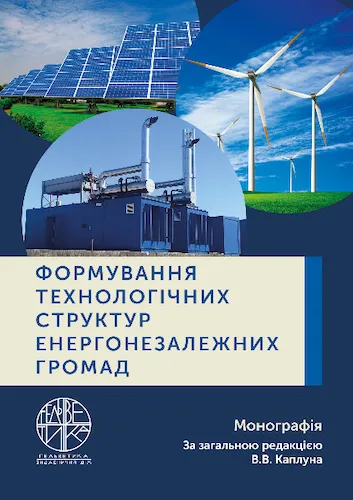
Formation of Technological Structures of Energy-Independent Communities: Monograph
V. Kaplun, M. Zablodskyi, V. Trokhanyak, S. Shvorov, I. Radko, V. Stanytsina, T. Nechaeva, O. Teslenko, S. Makarevych, D. Sorokin, S. Kovalchuk, V. Horskyi, I.Y Yakymenko. / edited by V.V. Kaplun / National University of Life and Environmental Sciences of Ukraine; General Energy Institute of NAS of Ukraine. – Odesa: Publishing House “Helvetica”, 2024. – 312 p. (in Ukrainian)
The monograph is dedicated to the solution of the important problem of the development of technological structures of providing certain united territorial communities with primary and derivative energy resources to achieve economically feasible energy independence and minimizing the negative impact on the environment. The monograph is intended for specialists engaged in the development of methods and means to improve the efficiency of regional energy supply based on local microenergy systems, engineers, researchers, students and postgraduates of energy specialties. The research was supported by the National Research Foundation of Ukraine within the framework of the competition “Science for the Restoration of Ukraine in the War and Postwar Periods” under grants № 202/0129 and № 94/0129.
Models and methods of improving the efficiency and safety of the operation of thermal power equipment
V.P. Babak, A.O. Zaporozhets, A.D. Sverdlova, V.V. Khaidurov / Kyiv: PH “Naukova Dumka”, 2024. – 200 p. ISBN 978-966-00-1931-7. (in Ukrainian)
The monograph examines modern problems of increasing the efficiency and safety of the operation of thermal power equipment and ways to solve them. The available methods and systems for diagnosing complex thermal power facilities have been analysed and systematised. The features and parameters of diagnosing elements of complex thermal power facilities are presented, the general requirements for diagnostic systems are substantiated. Mathematical models of the investigated fields are developed, models and characteristics of the input signals of the measuring modules of the proposed information-measuring system of diagnostics using current and retrospective information are described. Methods of forecasting abnormal states of complex thermal power objects using machine learning algorithms with LSTM architectures have been developed. A system for monitoring and controlling the process of fuel combustion in small and medium power boilers is proposed, which is based on the use of an oxygen sensor and frequency-regulated blowing fans. A method of measuring the coefficient of excess air taking into account the current volume concentration of oxygen in the air is proposed. Modern methods and algorithms for solving linear and non-linear inverse heat conduction problems of various nature are considered. A technique for obtaining the numerical solution of the main classes of inverse problems of heat conduction has been developed, which makes it possible to reduce the total number of calculations required to find the global minimum of the quadratic functional used in the formulation of most inverse problems.
2023

Advanced Information-Measuring Technologies and Systems
Eremenko V., Zaporozhets A. (eds). Springer. 2023. 289 р.
The book presents the main scientific directions and issues of research conducted in the Department of Information and Measurement Technologies at the National Technical University of Ukraine “Ihor Sikorskyi Kyiv Polytechnic Institute”. The presented results cover almost all scientific directions related to information and measurement technologies—metrological support of measurement channels of information and measurement systems, methods of reproducing units of electric circuit parameters, development of specialized information and measurement systems, mathematical methods of processing measurement information, models of formation of information signals and fields, statistical diagnostic methods, information support of testing, and calibration laboratories.
Systems, Decision and Control in Energy IV: Volume I. Modern Power Systems and Clean Energy
ed. by A. Zaporozhets // Springer, 2023. – 463 p.
The concept of “energy” includes methods for obtaining and using various types of energy for the needs of human society. Energy is one of the foundations for the development of modern society. The effectiveness of solving social, economic and technical problems, as well as the anthropogenic transformations of nature, is largely determined by energy production and the scale of energy production.Modern energy is not a separate industry, but it penetrates widely into other areas, in particular, chemical, transport, aerospace, construction, metallurgy, engineering, agriculture, etc. The energy sector is based on complex technical systems that are multicomponent, spatially distributed systems that during their operation are affected to a wide range of design and non-design thermomechanical loading conditions, the effects of aggressive fields and units, unauthorized influences (operator errors, terrorism, sabotage) and can reach various limit states.
Complex technical systemsare characterized by complex non-linear interactions between their constituent elements, complex chains (scenarios) of cause-effect relationships between hazardous, probabilistic events and processes that occur during their life. These scenarios can be implemented over complex ramified scenario trees.
Ensuring the operational reliability, durability and safety of power equipment is a difficult task, which is associated with the organization of the reliability of control over the operation of power plants and ensuring optimal conditions for their operation. In this regard, we can distinguish a whole class of tasks related to the development of control systems, diagnostics and monitoring in the energy industry, which are presented in this book. Of particular relevance now is the use of UAVs in the energy sector.
Particular attention must be paid to the environmental consequences of the operation of energy facilities, the main of which is significant environmental pollution in large cities and industrial areas.The development of environmental management information systems is the prerogative of the state, corporations and one of the main directions of the national informatization policy. A clearly debugged system of environmental monitoring gives a general idea of the features of the current ecological state, the main directions of state policy in the field of environmental protection, the use of natural resources and environmental safety. The methodology and hardware-software tools for monitoring the state of the environment presented in the monograph are effective tools for supporting decision-making in managing the environmental safety of the atmosphere during its technogenic pollution.

Systems, Decision and Control in Energy IV: Volume IІ. Nuclear and Environmental Safety
eds. by Zaporozhets A., Popov O. / Springer, 2023. – 353 p.
In recent years, the scale of environmental hazards has been growing, emergencies occur more often at special facilities, in particular nuclear power, the largest of which was the accident at the Chernobyl nuclear power plant in Ukraine on April 26, 1986. With the advent of nuclear power, it was believed that nuclear power reactors were safe enough, control and monitoring systems, protective screens and trained personnel would guarantee their trouble-free operation. There is also a trend now that nuclear power is “environmentally friendly” because it provides a reduction in greenhouse gas emissions with replacing power plants working on fossil fuels. Some countries, such as the United States, have recently classified nuclear energy as a renewable energy source. Despite this, nuclear power is potentially dangerous due to:
- possible accidents at power plants, accompanied by the ejection of radioactive materials into the environment;
- ejections of about 250 radioactive isotopes into the environment as a result of the operation of nuclear reactors;
- emissions of 85Kr, which changes the electrical conductivity of the atmosphere. This gas behaves like a greenhouse gas in the atmosphere, thereby contributing to anthropogenic climate change on Earth;
- pollution of the biosphere with plutonium;
- radioactive waste is the most important cause of environmental hazard, which remains unresolved.
Civilian nuclear power reactors operating throughout the world annually generate large amounts of low-, medium- and high-level radioactive waste. Radioactive pollution accompanies all parts of the complex production of nuclear energy: the extraction and processing of uranium, the operation of nuclear power plants, the storage and regeneration of fuel, which has a significant impact on the environmental friendliness of nuclear energy. In addition, up to 300 natural and technogenic emergencies are registered annually, as a result of which people die and great economic damage is caused. The main reasons for the occurrence of technogenic accidents and catastrophes and the strengthening of the negative impact due to the occurrence of natural and technogenic emergencies in Ukraine are: obsolete fixed assets, in particular for environmental purposes; large volume of transportation, storage and use of hazardous substances; the emergency state of a significant part of public utility networks; insufficient investment support for the process of introducing the latest resource-saving and environmentally friendly technologies in environmentally hazardous industries, primarily in the metallurgical, chemical, petrochemical and energy sectors; environmental problems associated with significant changes in the state of the geological and hydrogeological environment and caused by the closure of unprofitable mining enterprises and mines; unwillingness of economic subjects to take measures to prevent accidents and catastrophes at high-risk and potentially hazardous facilities.
Power Systems Research and Operation: Selected Problems II
eds. by Kyrylenko O., Denysiuk S., Derevianko D., Blinov I., Zaitsev I., Zaporozhets A. // Springer International Publishing, 2023. – 346 p.
The book examines the problems in the fields of power systems functioning, optimization of operating modes of electric power facilities and their control systems, information and measuring systems and metrological support in the electric power industry, ensuring the functioning of the electric power system in the conditions of a competitive market of the electric power. The book is devoted to modern problems ensuring operational reliability and safety of objects integrated power system of Ukraine in the areas such as distribution systems automation, forecasting and optimization of energy processes with solar power plants, hydropower plants and other plants, and development solutions for smart monitoring systems for DERs. The presented research results in the book allow to increase the reliability and efficiency of operation of energy facilities and ensure the stability of power systems, the introduction of effective methods and tools for forecasting electricity supply and optimize power systems taking into constraints in modern of electricity markets. The book consists of 14 chapters. The book is for researchers, engineers, as well as lecturers and postgraduates of higher education institutions dealing with problems of operation, control, diagnosis and monitoring of integrated power system, power equipment, and other.

Electromagnetic Field Near Conducting Half-Space
Ed. by Vasetsky Y., Zaporozhets A. // Springer Cham, 2023. 124 p. Hardcover ISBN 978-3-031-38422-6. eBook ISBN 978-3-031-38423-3.
The book is devoted to the solution of one general problem of the theory of a three-dimensional quasi-stationary sinusoidal and pulse electromagnetic field. These studies, unlike many well-known works, are based on obtained exact analytical solution of the problem for the field, generated by external current sources near the conducting body with plane surface. The solution for the vector and scalar potentials, electric and magnetic intensities in the dielectric and conducting media is found without restrictions on the configuration of current sources, properties of the media and field frequency. Some general properties of field formation for arbitrary field in the considered system are obtained (in particular, full compensation by the field of the electric charge distributed on the interface between the media, the normal component of the induced external electric field and, accordingly, the equality to zero the components both of the current density and the electric field intensity perpendicular to the interface; the non-uniform electromagnetic field decreases in depth of conducting medium faster than uniform field). It is shown that the exact analytical solution depends on the values of the parameter proportional to the ratio of the field penetration depth to the distance between the external field sources and the body. The concept of strong skin effect is extended to the case of small value of the introduced parameter. A significant simplification of the expressions was obtained as an asymptotic expansion on this small parameter. In the case of pulsed fields approximate method gives the highest accuracy during important initial period of pulse time. For asymptotic expansion the approximate impedance boundary condition is generalized to the diffusion of non-uniform field into conducting medium. The book is intended for the researchers, postgraduate students and students specialized in theory and calculations of electromagnetic fields.
National Security Drivers of Ukraine. Contributions to Political Science
Editors: Radchenko O.1, Kovach V.2, Semenets-Orlova I.3, Zaporozhets A. 4 // Springer Cham, 2023. – 124 p. Hardcover ISBN 978-3-031-33723-9. eBook
ISBN 978-3-031-33724-6.
This volume presents the key informational, communication, and socio-political drivers of the Ukrainian state’s national security. Since the beginning of the third millennium, there has been an aggravation of global inter-civilizational confrontations, which in 2022 has already resulted in an open military aggression against Ukraine. The hybrid wars against the world of democracy have put ensuring the national security of states on the front pages of world and national agendas.
Using the example of Ukraine, the book demonstrates how, in order to achieve their geopolitical interests, authoritarian regimes incite information wars as a prerequisite for the transition to an armed “hot” war. It further shows how these processes actualize the formation of a fundamentally new state policy to ensure information and, more broadly, national security. The book identifies the main threats to national security in modern states and identifies ways of protecting Ukraine’s national interests.
The book will appeal to scholars, students, and researchers of political science, international relations, social sciences, and neighboring disciplines, as well as practitioners and policy-makers interested in a better understanding of national security drivers and protecting national interests.
Systems, Decision and Control in Energy V
ed. by Artur Zaporozhets1 // Springer, Cham, 2023. – 828 p. Hardcover ISBN 978-3-031-35087-0. eBook ISBN 978-3-031-35088-7.
The book consists of 8 parts: Energy Informatics, Electric Power Engineering, Heat Power Engineering, Nuclear Power Engineering, Renewable Power Engineering, Fuels, Transport, and Environmental Safety. The results presented in this book are aimed at solving some of the technical issues proposed by the Ukraine Recovery Plan and other important scientific and applied problems in the field of energy. Scientists from leading Ukrainian academic institutions and universities are working on this book.
This book is for scientists, researchers, engineers, as well as lecturers and postgraduates of higher education institutions dealing with energy sector, power systems, ecological safety, etc.
Relay Protection and Automation in Power Engineering and Transport
Ye.І. Sokol, O.H. Hryb, І.Т. Karpaliuk, V.М. Bazhenov, А.О. Zaporozhets, D.А. Hapon, V.P. Staretskii, V.V. Skopenko, V.І. Vasylchenko, О.Yu. Zakovorotnyi, S.V. Shvets, О.О. Svetelik, R.М. Lisichenko, Т.S. Donetska, R.І. Demianenko, Ye.О. Kaurkin, О.V. Luka // Kharkiv: Brovin О.V., 2023. – 504 pp. (in Ukrainian)
The monograph examines types of relay protection of electrical installations of power supply and power consumption systems: power units, buses, power lines, transformers. Attention is paid to the protection of traction networks of railway transport. The principles of protection by automatic frequency discharge and protection using fuses and automatic switches are described. Protection schemes and many calculation examples are given in the work. The monograph is intended for students and post-graduate students of electrical engineering specialties.

Manufacturing Control of Textile Materials: Operational Computerized Non-contact Methods
Valerii Zdorenko, Nataliia Zashchepkina, Sergiy Barylko, Artur Zaporozhets, Serhii Lisovets, Ihor Kiva // Springer, 2023. – 289 p.
The book consists of 8 parts: Energy Informatics, Electric Power Engineering, Heat Power Engineering, Nuclear Power Engineering, Renewable Power Engineering, Fuels, Transport, and Environmental Safety. The results presented in this book are aimed at solving some of the technical issues proposed by the Ukraine Recovery Plan and other important scientific and applied problems in the field of energy. Scientists from leading Ukrainian academic institutions and universities are working on this book.
This book is for scientists, researchers, engineers, as well as lecturers and postgraduates of higher education institutions dealing with energy sector, power systems, ecological safety, etc.
Relay Protection in Power Supply Systems
Ye.I. Sokol, V.Ye. Kryvonohov, O.H. Hryb, I.T. Karpaliuk, A.O. Zaporozhets, V.P. Starenkyi, V.V. Skopenko, O.Yu. Zakovorotnyi, R.M. Lysychenko, Ye.O. Kaurkin, O.V. Luka // Kh.: FOP Brovin O.V., 2023. – 426 p. (in Ukrainian)
The monograph deals with relay protection of objects in power supply systems. General principles of protection, requirements for them, features of primary measuring current and voltage converters, protection of power supply lines, transformers, generators, engines, tires are covered. Features of implementation of schemes of relay protection devices are considered. The monograph is intended for students and post-graduate students of electrical engineering specialties.
Municipal Thermal Power Engineering: Energy Efficiency, Management Structure, Energy Service Services
Ковалко О.М., Ковалко Н.М., Євтухова Т.О., Новосельцев О.В.
Kovalko O.M., Kovalko N.M., Yevtukhova T.O., Novoseltsev O.V. / Collection of works under general ed. of member-cor. of NAS of Ukraine O.V Novoseltsev. – Kyiv.: NAS of Ukraine, Institute of General Energy, 2023. – 720 p. ISBN 978-966-02-9489-9.
(in Ukrainian)
In memory of Oleksandr Mikhailovich Kovalko
The monograph examines methods and models of multi-level systems of management and regulation in the field of energy efficiency and energy saving, as well as vertically integrated structures of their organization. On the basis of a systemically coordinated combination of the provisions of the theory of hierarchical multilevel systems and the set-theoretical approach, an algorithm was developed and the parameters and structure of the hybrid energy system were
optimized at the level of communal heat engineering. The methodological foundations are deepened and the classification of energy services is carried out, new possibilities for the use of energy-oriented services in the energy sector are shown. For scientific and researchers and engineers involved in the problems of energy, energy management, and energy conservation, as well as for lecturers, graduate students, and university students.
Textbooks and Manuals
Probability Theory, Stochastic Processes and Mathematical Statistics, Electronic Training Course
M.Ye. Fryz. Ternopil National Technical University named after I. Puluj, Certificate No. 406 dated April 21, 2023.
The e-learning course Probability Theory, Probability Processes, and Mathematical Statistics is intended for students who obtain a bachelor’s degree in TNTU with majors 122 “Computer Science” and 126 “Information Systems and Technologies”. Contains lecture material, tasks, and examples of laboratory work (text part, video materials, examples of Python programs), and test tasks. They are implemented using LMS ATutor.
Methodological Guidelines for Laboratory Classes in the Course “Methods and Systems of Simulation Modeling of Information Signals and Systems” (Module 1)
B.B. Mlynko, M.Ye. Fryz. – Ternopil: TNTU Publishing House named after I. Puluj, 2023. – 21 p. (in Ukrainian)
The proposed manual contains methodical instructions for laboratory classes, the subject of which is related to the methods of computer simulation modeling of random variables and processes.
Methods and Algorithms of Digital Image Processing. Software Implementation in MATLAB
S.V. Sinichenko, V.V. Khaidurov, T.I. Tsiupii, T.A. Zhovnovach, L.M. Shcherbak. Study manual for students majoring in 121 – Software Engineering, 122 – Computer Science, and 125 – Cybersecurity. Recommended by the Academic Council of Kyiv International University. Minutes No. 9 of May 29, 2023. (in Ukrainian)
The training manual contains methods and algorithms of digital image processing used to highlight contours of graphic elements in images, methods of image processing using numerical interpolation methods, methods of modern digital image processing in various applied tasks based on the equations of mathematical physics, and methods of processing graphic objects in real-time with elements of machine learning. The manual provides steganographic methods of digital image processing, which are actively used in the tasks of protecting graphics, for example, copyright objects.
Appendices of the manual contain the main software implementations of methods and algorithms in the MATLAB R2019a application software package, which are used in practice, as well as the results of experiments on the considered problems.
The study guide is intended for students of the “Computer Science and Information Technologies” specialty, postgraduate students of technical specialties, teachers, and researchers engaged in the digital processing of graphic data.
Concise Ukrainian-English Explanatory Dictionary of Terms in Eddy Current Non-Destructive Testing
Yu.V. Kuts, V.M. Uchanin, Yu.Yu. Lysenko. – Kyiv: Igor Sikorsky Kyiv Polytechnic Institute, 2023. – 63 p. [Electronic resource] (in Ukrainian)
The explanatory dictionary (Basic terms used in eddy current non-destructive testing) is an important reference source for students, masters, postgraduates, doctoral students, and scientific and engineering workers who work with eddy current non-destructive testing. The dictionary contains the most used terms and established terminological phrases that correspond to modern professional vocabulary and the language of scientific publications and international conferences in the eddy current non-destructive testing field. A significant part of the terms in the dictionary is based on the European standard EN 1330-5:1998 Non-destructive testing – Terminology – Part 5: Terms used in Eddy Current Testing. Therefore, this dictionary is an indispensable reference guide for anyone working with this standard and those who wish to expand their knowledge in the field of eddy current non-destructive testing. This dictionary may also be useful for those who need precise terminology in this field of knowledge.
2022
Metrology of heat flux measurements
V.P. Babak, S.I. Kovtun, L.V. Dekusha. Ed. by Corr. Memb. of the NAS of Ukraine V. Babak, Institute of Engineering Termophysics of the NAS of Ukraine. Kyiv: Akademperiodyka, 2022. – 122 p. ISBN 978-966-360-456-5.
The monograph examines the issues of metrology of heat fl ux measurements. The results of analytical researches of the uncertainty of results of measurement of the surface density of a heat flux are presented, the basic physical mechanisms of formation and transfer of a unit of measurement of the surface density of heat flux are stated, the modular metrological complex for the reproduction of the measurement unit of heat flux and hierarchical scheme for traceability of measurement results are considered.
For researchers, engineers, as well as lecturers and postgraduates of higher education institutions dealing with the problems of thermophysical measurements and thermal energy audit.

Power Systems Research and Operation: Selected Problems
d. by O. Kyrylenko, A. Zharkin, O. Butkevych, O. Blinov, I. Zaitsev, A. Zaporozhets // Springer International Publishing, 2022. – 174 p. ISBN 978-3-030-82925-4. Scopus
This book examines the problems of power systems in fields related to optimization of operating modes of electric power facilities and their control systems, information and measuring systems and metrological support in the electric power industry, ensuring the functioning of the electric power system in the conditions of a competitive market of the electric power. The book is devoted to modern problems ensuring operational reliability and safety of objects integrated power system of Ukraine. It is complex task, solution of which is related to optimization of operating modes of electric power facilities and their control systems, creating diagnostic systems for the electric power industry, ensuring the functioning of the electric power system in the conditions of a competitive market of the electric power. The presented research results in book allow increasing the reliability and efficiency of operation of energy facilities and ensuring the stability of power systems, the introduction of effective methods and tools for forecasting electricity supply, optimize power systems, suggest road map to integrate electricity markets taking into account network constraints in modern conditions of electricity markets. The book includes eight chapters. A book is for researchers, engineers, as well as lecturers and postgraduates of higher education institutions dealing with problems of operation, control, diagnosis and monitoring of integrated power system, power equipment and other.
Wear-resistant protective coating
V.V. Shchepetov, S.D. Kharchenko, O.V. Kharchenko. Ed. by Cor. Member of the NAS of Ukraine V.P. Babak. Naukova Dumka. 2022. – 112 p. ISBN: 978-966-00-1812-9. (in Ukrainian)
Considered modern technologies for the formation of composite detonation crystalline and amorphous-crystalline coatings, their friction and wear under the conditions of the presence and absence of lubricant, compatibility with structural and antifriction materials, as well as the influence of the stress state on their formation.
The monograph consists of six chapters.
Chapter 1 discusses the general issues of friction and wear research of composite detonation coatings in the absence of lubricant. It is shown how the sliding speed affects the wear of the friction surfaces. The evaluation of the features of wear in conditions of heavily loaded contact and the formation of coatings in conditions of elevated temperatures is given.
Chapter 2 shows how the presence of lubricant affects the wear of composite detonation coatings. The role of tribochemical processes in the formation of wear-resistant surface structures and the wear resistance of coatings in the presence of lubricant in contact, the influence of elemental-organic additives on the processes of friction and wear are revealed.
Chapter 3 deals with the compatibility of coatings with antifriction and structural materials. On the basis of the obtained results, friction pairs from structural and antifriction materials were selected, as well as the operational stability of detonation coatings in these friction pairs was studied.
Chapter 4 describes the principles of forming amorphous and amorphous-crystalline coatings. The selection and justification of the components of the wear-resistant amorphous-crystalline coating, their influence of the nature of alloying elements on the properties of zirconium-based coatings are considered. The influence of technological parameters of detonation sputtering on the formation of detonation amorphous-crystalline coatings.
Chapter 5 presents the results of research on friction and wear of amorphous-crystalline coatings in the absence of lubricant. The wear resistance of amorphous-crystalline coatings in friction with tested coatings was studied. The wear resistance of amorphous-crystalline coatings with aircraft steels and the patterns of wear of amorphous-crystalline coatings with anti-friction materials were studied.
Chapter 6 examines the features of the formation of the stress state of amorphous-crystalline detonation coatings. An assessment of the level of technological residual stresses in friction pairs and their effect on wear resistance was carried out. The influence of residual stresses on the wear resistance of the obtained coatings is shown.
For researchers, engineers, as well as teachers, graduate students and students of higher educational institutions dealing with the problems of formation and research of detonation coatings.
Systems, Decision and Control in Energy III
ed. by Artur Zaporozhets // Springer International Publishing, 2022. – 386 p. Hardcover ISBN 978-3-030-87674-6. eBook ISBN 978-3-030-87675-3. Scopus
This book describes new energy saving methods and technologies for heat power engineering. The book is devoted to topical issues of energy and related industries. Leading Ukrainian scientists from both scientific institutes and educational universities took part in its creation. The research results are presented in 6 parts: electrical engineering, heat power engineering, nuclear power engineering, fossil fuels, cybersecurity and computer science, environmental safety. Results of regulating of operating modes and applicability of model checking technique in power systems are showed. Separate block of questions regarding the functioning of nuclear power plants, their waste and preventive measures of protection against negative effects on living organisms (including, for example, the Chernobyl nuclear power plant) is considered. The results of the peculiarities of the extraction, purification and use of fossil fuels are presented. In some chapters, presented the results on improving thecybersecurity of energy systems and its resilience to various threats, including the use of 5G technology. Traditionally for this series, issues of ecological safety, the impact of different energy systems on the environment and its protection are considered. A book is for researchers, engineers, as well as lecturers and postgraduates of higher education institutions dealing with energy sector, power systems, ecological safety, etc.

Advanced Energy Technologies and Systems I
ed. by Artur Zaporozhets // Springer International Publishing, 2022. – 115 p. ISBN 978-3-030-85745-5. eBook ISBN 978-3-030-85746-2. Scopus
This book focuses on modern technologies and systems for solving problems in the energy sector. It is shown that bioenergy is one of the promising areas of energy development. The book collected the experience of scientists from many countries in the research of renewable energy. The advantages of renewable energy are general availability, renewability, environmental friendliness. The analysis carried out by the authors shows the current state of renewable energy in the world, its trends and prospects. New measuring systems are presented, which can become the basis for measuring the thermal characteristics of various types of fuels, including biofuels, insulating materials, enclosing structures, etc. System for monitoring of grainy biomass comminution with the use of genetic algorithms has been presented and described. New technologies for the construction of power plants based on renewable energy sources have been proposed and investigated.
Textbooks and Manuals
Theoretical Foundations of Information Protection
B.B. Akhmetov, V.P. Babak, Zh.K. Alimseitova. Theoretical Foundations of Information Protection. Textbook. — Aktau: EU, 2022. – 685 p. – ISBN 978-601-08-1831-6. (in Ukrainian) (Б.Б. Ахметов, В.П. Бабак, Ж.К. Алимсеитова. Акпаратты корежулык теориялык негіздері. Окулык. – Актау. ЕУ, 2022 – 685 б. ISBN 978-601-08-1831-6)
The textbook deals with the mathematical apparatus of transformation and research of information signals, technology of measurement, transmission and processing of information, signals and data, interference-resistant coding, use of modern information and communication channels of information transmission, encryption and reverse encryption algorithms, stegano- and cryptography, digital signature, etc. Basic concepts and methods of information protection are described. In addition to algorithmic and technical methods, protection of confidential and commercial information, protection against unauthorized access, protection of intellectual property, legal protection of information, as well as international standards in the field of information protection are ensured. The textbook is intended for “Informatics”, “Training of informatics teachers”, as well as students and postgraduates studying in the direction of “Information and communication technologies”. The textbook is intended for the educational areas of “Informatics”, “Training of teachers of informatics”, as well as students and postgraduates studying in the area of ”Information and Communication Technologies”.
Heat Conduction Theory: Textbook for Students Majoring in 105 “Applied Physics and Nanomaterials”
A.V. Hilchuk, A.A. Khalatov, T.V. Donyk; Igor Sikorsky Kyiv Polytechnic Institute. – Kyiv: Igor Sikorsky Kyiv Polytechnic Institute, 2022. – 131 p. (in Ukrainian)
The textbook for the course “Theory of heat conduction” is intended for students studying in the specialty 105 “Applied physics and nanomaterials”. The textbook covers such questions as setting and solving steady-state heat conduction equations without heat sources and with heat sources in different coordinate systems with boundary conditions of the first and third kind, non-stationary equations for an unbounded plate, cylinder and sphere, heat exchange through ribbed surfaces and porous walls, the basics of the theory of Bessel functions are provided.
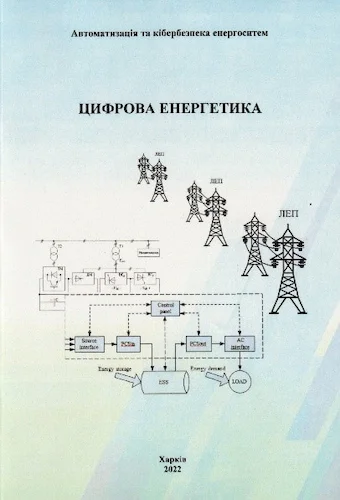
Digital Energy
Ye.I. Sokol, O.H. Hryb, I.T. Karpaliuk, A.O. Zaporozhets, D.A. Hapon, S.S. Kozlov, O.Yu. Zakovorotnyi, V.P. Starenkyi, N.M. Shmatko, K.V. Kamchatna-Stepanova // Kh.: FOP Brovin O.V., 2022. – 212 p. – ISBN 978-617-8009-72-4. (in Ukrainian)
The textbook considers an approach to the design and operation of modern power supply systems, where both traditional and alternative energy sources are present, and for their joint operation it is necessary to solve a number of issues achieved by combining them into Smart Grid energy system. The textbook is intended for students and graduate students of electric power specialties.
Special Chapters of Mathematics. Lecture Course [Electronic resource]: Textbook for Bachelor’s Degree Applicants under the Educational Program “Computer-Integrated Systems and Technologies in Instrument Making” of Specialty 151 Automation and Computer-Integrated Technologies
Yu.V. Kuts, Yu.Yu. Lysenko; Igor Sikorsky Kyiv Polytechnic Institute. – Electronic textual data (1 file: 3 MB). – Kyiv: Igor Sikorsky Kyiv Polytechnic Institute, 2022. – 180 p. (in Ukrainian)
Modern scientific and technical progress requires the development of new and adaptation of existing methods and algorithmic-software means of measurement and control, means of automation of production processes, constant improvement of processing methods, and presentation of measurement results. All this requires knowledge and experience in the practical application of methods and criteria of mathematical statistics. The study guide consists of four chapters and contains lecture materials on general issues, in particular, issues of the Laplace transform, probability theory, mathematical statistics, and random processes are covered. Each chapter is accompanied by control questions to check the assimilation of knowledge, self-control, and independent work. Reference material is provided for familiarization and understanding of the processes. This manual is intended for bachelor’s degree holders in the specialty “Automation and computer-integrated technologies” and related specialties, as well as scientific and engineering-technical workers, and specialists who are engaged in the development of computer-integrated systems and technologies in the field of instrumentation.
Modern Systems and Technologies. Part I. General Issues of Construction and Data Processing in Computer-Integrated NDT Systems [Electronic resource]: Textbook for Bachelor’s Degree Applicants under the Educational Program “Computer-Integrated Systems and Technologies in Instrument Making” of Specialty 151 Automation and Computer-Integrated Technologies
Yu.V. Kuts, Yu.Yu. Lysenko, A.S. Momot; Igor Sikorsky Kyiv Polytechnic Institute. – Electronic textual data (1 file: 2.59 MB). – Kyiv: Igor Sikorsky Kyiv Polytechnic Institute, 2022. – 123 p. (in Ukrainian)
The widespread use of computer technology creates new conditions for the development of computer-integrated systems of non-destructive control and technical (CIS NDCT), which makes it possible to automate the process of control and diagnostics, to increase the probability of control due to the exclusion or minimization of the operator’s role in decision-making, application more powerful methods of digital processing of information signals, statistical methods of processing experimental data. The training manual is devoted to the construction of the latest automated CSIs NDCT and the technology of processing information signals in them, and examples of the construction of such systems are given. Reference material is provided for familiarization and understanding of the processes. This manual is intended for master’s degree holders in the specialty “Automation and computer-integrated technologies” and related specialties, as well as scientific and engineering-technical workers, specialists who are engaged in the development of computer-integrated systems and technologies in the field of instrument engineering with the aim of implementing non-destructive control and diagnostics of objects.
Fundamentals of Digital and Analog Circuit Engineering. Computer Practicum. Study Manual – 2022
V.P. Rozen, O.O. Zakladnyi, S.L. Priadko, V.H. Smoliar. (in Ukrainian)
The presented manual outlines the basic provisions for performing practical work using special computer programs, the subject of which includes the sections of the course on studying digital electronics and circuit engineering. The educational edition for the implementation of practical work contains basic theoretical information, the work program, instructions for its implementation, the content of the report, and control responses. The principles of construction of combination devices, adders, multiplexers, decoders, and devices with memory on digital logic elements are considered. The methods of logical description of their work are given, as well as the basis of analysis and directed synthesis of devices with the necessary technical characteristics. The main attention is paid to the schematic implementation of various functions of electronic devices with verification of completed tasks. The purpose of the practical work is for the student to acquire the necessary skills in the synthesis of electronic circuits for further application in the study of professionally oriented disciplines. The educational edition is intended for bachelor’s degree holders in the specialty 141 “Electrical power engineering, electrical engineering, and electromechanics”, the educational program “Engineering of intelligent electrotechnical and mechatronic complexes”.
Electric Drive with a BLDC Motor. Calculation and Graphic Work [Electronic resource]: Textbook for Bachelor’s Degree Applicants under the Educational Programs “Energy Management and Energy Efficient Technologies”, “Systems for Providing Consumers with Electrical Energy” of Specialty 141 Electric Power Engineering, Electrical Engineering and Electromechanics
V.P. Rozen, O.O. Zakladnyi, S.L. Priadko; Igor Sikorsky Kyiv Polytechnic Institute. – Electronic textual data (1 file: 1.05 MB). – Kyiv: Igor Sikorsky Kyiv Polytechnic Institute, 2022. (in Ukrainian)
The presented training manual outlines the main provisions for performing calculation and graphic work, the subject of which includes the sections of the electric drive with electric valve motor course of the educational discipline “Electric Drive”. Calculation tasks and the sequence of tasks are given. The procedure for calculating the static and dynamic characteristics of AC electric drives with a synchronous motor and a static converter, the construction of graphs of load diagrams, as well as the calculation of energy indicators: energy losses, efficiency, and power factor is considered. The educational edition is intended for bachelor’s degree holders in the specialty 141 “Electrical power engineering, electrical engineering and electromechanics”, in the educational programs “Energy management and energy-efficient technologies”, and “Systems of providing consumers with electrical energy”.
Mathematics Manual for Preparatory Course Students. Study Manual
N.H. Batechko, L.A. Pantaliienko, V.V. Khaidurov, T.I. Tsiupii, S.V. Shostak. NUBiP of Ukraine, 2022. – 250 p. (in Ukrainian)
Pneumatics and Pneumatic Drives [Electronic resource]: Lecture Notes for Bachelor’s Degree Applicants of Specialty 131 “Applied Mechanics” under the Educational and Professional Program “Applied Mechanics” of Full-Time and Part-Time Forms of Study
L.O. Kryvoplias-Volodina, S.V. Tokarchuk, Z.A. Burova – K.: NUFT, 2022. – 105 p.
(in Ukrainian)
Pneumatics and Pneumatic Drives [Electronic resource]: Laboratory Practicum for Bachelor’s Degree Applicants of Specialty 131 “Applied Mechanics” under the Educational and Professional Program “Applied Mechanics” of Full-Time and Part-Time Forms of Study
Comp. L.O. Kryvoplias-Volodina, S.V. Tokarchuk, Z.A. Burova – K.: NUFT, 2022. – 63 p.
(in Ukrainian)
Methodological Guidelines for Laboratory Classes in the Course “Probability Theory, Stochastic Processes and Mathematical Statistics” (Module 1)
B.B. Mlynko, M.Ye. Fryz. – Ternopil: TNTU Publishing House named after I. Puluj, 2022. – 14 p. (in Ukrainian)
2021
Energy Efficiency and Energy Consumption Forecasting at Various Hierarchical Levels of the Economy: Methodology, Forecast Estimates up to 2040
M.M. Kulyk, O.Ye. Maliarenko, N.Yu. Maistrenko, V.V. Stanytsina, H.O. Kuts. – Kyiv, “Naukova Dumka”, 2021. – 236 p. – ISBN 978-966-00-1739-9. (in Ukrainian)
The monograph presents new developments in methods for determining energy efficiency indicators at different hierarchical levels, taking into account the impact of environmental protection factors, and provides methodological approaches to determining energy saving potentials: structural (when changing the structure of the economy as a whole and the structure of industrial sections) and technological (theoretical, technically possible and economically feasible) at different hierarchical levels of the economy.
Improved methods for forecasting the demand for energy resources (normative and direct account) at different hierarchical levels of the economy are proposed and a comprehensive method is proposed to reconcile forecasts obtained at different hierarchical levels on relevant indicators, increase the accuracy of forecasts, and reduce the number of forecast options. Forecast estimates of demand for fuel (in general, coal, natural gas, oil products), electricity, and heat until 2040 are given.
For scientific and engineering workers who deal with the problems of energy efficiency assessment, energy saving, and energy consumption forecasting, as well as for teachers, graduate students, and students in relevant specialties.
2020
Food, Energy, and Water Nexus for Sustainable Development: Integrated Modeling and Robust Management
Ed. by A.H. Zahorodnii, Yu.M. Yermoliev, V.L. Bohdanov, T.Yu. Yermolieva. – Kyiv, “Academperiodica”, 2020. – 446 p. M.M. Kulyk, S.V. Shulzhenko, T.P. Nechaieva, M.I. Kaplin, I.Ch. Leshchenko. Chapter 4. Methodology and Hierarchical System of Mathematical Models for Forecasting Long-Term Development of National Power Engineering under Uncertainty. P. 119–157. (in Ukrainian)
This book comprises research papers, summarizing the results of the joint research Project between the National Academy of Sciences of Ukraine and the International Institute for Applied Systems Analysis, Laxenburg, Austria. The main goal of the book is to present challenging problems of integrated robust management of interdependent food, energy, water, environment, social, and demographic systems for sustainable developments, which cannot be solved by the existing traditional approaches. The project develops a multimodel strategic-adaptive Decision Support System (DSS), which integrates not only national models but also those operating at the global scale, thus enabling to show policymakers the trade-offs and synergies of different policies, allowing for a dialogue between national and international stakeholders. The DSS includes a Data Base and a Toolbox of non-smooth stochastic optimization algorithms for distributed model linkage under asymmetric information, large-scale Machine Learning (ML), and Artificial Intelligence (AI) problems, in particular, deep artificial neural network (DANN) learning.
The book is prepared for scholars and practitioners interested in integrated food, energy, and water modeling and security management for sustainable development.
2018
Institute of General Energy of the National Academy of Sciences of Ukraine. History and Present
Ed. by M.M. Kulyk / Institute of General Energy of the National Academy of Sciences of Ukraine. – Kyiv: Institute of General Energy of the National Academy of Sciences of Ukraine, 2018. – 44 p. – ISBN 978-966-02-8532-3. (in Ukrainian)
The publication contains materials on the history of the establishment and development of the Institute of General Energy of the National Academy of Sciences of Ukraine. Information is given about the founders, goals of creation, and further development of the Institute, which has become one of the few scientific institutions of the country, at the world level conducts research on complex problems of long-term forecasting of energy development in modern economic, political and international conditions. Data on prominent Ukrainian scientists who worked at the Institute are provided. The most important results of scientific research obtained by scientists of the Institute of General Energy of the National Academy of Sciences of Ukraine, information on important state documents prepared by the team, and the results of international cooperation are presented. For researchers, graduate students and students of energy specialties of higher educational institutions, and all those interested in the history and present of Ukrainian science.
Heat Transfer Between Air and a Liquid Film Flowing Down a Profiled Surface
V.V. Dubrovskyi, O.M. Pydvysotskyi, O.A. Shraiber. – Institute of General Energy of the National Academy of Sciences of Ukraine. – K.: Institute of General Energy of the National Academy of Sciences of Ukraine, 2018. – 78 p. – ISBN 978-966-02-8460-9. (in Ukrainian)
In contrast to known studies of improving the heat exchange of a liquid or gas flow with a wall due to the formation of depressions in it, it is proposed to use similar profiling of the surface along which the liquid film flows to intensify its heat exchange with the gas medium. On the basis of the conducted experimental studies, the phenomenon of anomalous increase (by 2.5-2.8 times) of the intensity of heat exchange between liquid and gas on profiled surfaces was discovered. Generalized formulas for the coefficients of heat transfer from the film to the longitudinal or transverse flow of air have been obtained. Recommendations for choosing the most effective heat exchange surface have been developed. For engineers, researchers, graduate students and students who are interested in the problems of contact heat transfer and its intensification in relation to industrial devices.
2017
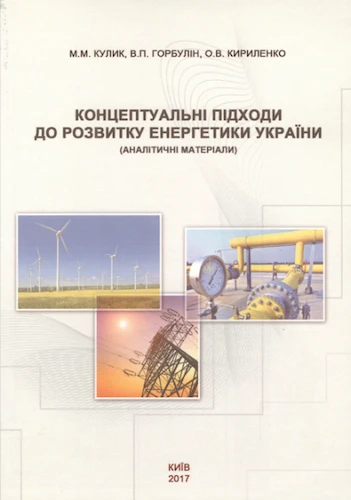
Conceptual Approaches to the Development of Ukraine’s Power Engineering (Analytical Materials)
M.M. Kulyk, V.P. Horbulin, O.V. Kyrylenko. – Institute of General Energy of the National Academy of Sciences of Ukraine, 2017. – 78 p. – ISBN 978-966-02-8281-0. (in Ukrainian)
In the presented analytical materials, the results of studies on the assessment of macroeconomic indicators of the development of the branches of the economy of Ukraine are presented, and on their basis, demand forecasts for the main types of energy resources have been developed. The obtained results were used to study the state and develop directions and levels of development of individual sectors of the energy industry for the period up to 2040. Environmental problems, issues of energy security are also highlighted, and the volumes, sources and mechanisms of necessary investment in the energy sector of the country are determined. The publication is intended for specialists who make management decisions on the issues of ensuring the further development of the energy industry, as well as scientific and engineering and technical workers, managers who work in the field of the fuel and energy complex. It can be useful for teachers and students of universities.

Theoretical and Applied Foundations of Economic, Environmental and Technological Functioning of Energy Facilities
V.O. Artemchuk, T.R. Bilan, I.V. Blinov et al. [ed. by A.O. Zaporozhets, T.R. Bilan]. – National Academy of Sciences of Ukraine. Department of Physical and Technical Problems of Energy. – Kyiv, 2017. – 312 p. (17.6 acad. publ. sheets). – Circulation 300 copies. – ISBN 978-966-02-8331-2. (in Ukrainian)
The monograph examines the development of the energy industry of Ukraine. Methods and management models of individual segments of the electric energy market are analyzed. Modern methods and means of monitoring energy objects at the stages of production, transportation, and consumption of electric and thermal energy are presented. The results of the analysis and visualization of environmental monitoring data to solve the problems of environmental safety management of energy facilities are presented. Researchers, engineers, as well as teachers, graduate students, and students of higher educational institutions dealing with the problems of modernization and functioning of energy facilities.
2014
Energy-Economic Analysis of Combined Systems of Electricity and Heat Generation
Power Engineering. S.V. Dubovskyi. Energy-Economic Analysis of Combined Systems of Electricity and Heat Generation. – K. – Naukova Dumka. – 2014. – 186 p. (14.95 conv. print. sheets) – Circulation 300 copies. – ISBN 978-966-00-1447-3. (in Ukrainian)
Within the framework of the thermodynamic approach, a new solution is presented for the scientific problem of energy cost allocation between the products of real processes and cycles of direct and reverse thermomechanical conversion, which form the basis for the functioning of combined electricity and heat generation systems – cogeneration of electricity and heat, as well as heat and cold using electricity. The work provides the theoretical foundations, methods, and means for determining the energy intensity of intermediate and final products of combined production processes of practically important types, along with aggregated models and engineering methodologies for energy-economic analysis and forecasting of their development as a two-product component of the electric power complex.
Energy Efficient Development Policy and Climate Change
Co-authored with scientists: V.Ya. Shevchuk (Member of the Interdepartmental Commission on Scientific and Technological Security under the National Security and Defense Council of Ukraine), Acad. of the NALS of Ukraine N.R. Malysheva (V.M. Koretsky Institute of State and Law of the NAS of Ukraine), Cor. Member of the NAS of Ukraine I.H. Mansurov (Research Economic Institute of the Ministry of Economic Development and Trade of Ukraine), Acad. of the NAAS of Ukraine A.V. Yatsyk (National University of Water and Environmental Engineering) and others, a monograph was published by Leading Researcher, PhD in Technical Sciences, Senior Researcher B.A. Kostiukovskyi and Head of Department, PhD in Technical Sciences S.V. Shulzhenko: Energy Efficient Development Policy and Climate Change. Monograph / V.Ya. Shevchuk, N.R. Malysheva, T.T. Kovalchuk, I.H. Mansurov et al. // Ed. by V.Ya. Shevchuk – K.: CP “Comprint”. – 2014. – 218 p. (123.5 conv. print. sheets) – Circulation 350 copies. – ISBN 978-617-7202-18-8. (in Ukrainian)
The transition to an energy-efficient development policy in Ukraine under global climate change is an objectively determined process. This is the only way to achieve dynamic growth of the gross domestic product and a reduction in its energy and carbon intensity, which is a pathway to solving acute economic, social, and environmental problems, as well as ensuring the national and, in particular, energy security of the state.
The book diagnoses modern problems of Ukraine’s economic development under global climate change and analyzes state strategic documents intended to guide the development of the national economy. Primary attention is paid to baseline industries and sectors – industry, energy, transport, housing and communal services, and the agro-industrial complex. The problems of forming and implementing the state development strategy are disclosed, and the directions of state regulation of the energy-efficient development of Ukraine’s economy are substantiated in the context of implementing the Association Agreement between Ukraine and the European Union.
Energy. Introduction to the Theory of Energy Efficiency of Multilevel Systems: Methods and Models of Energy Management in the Housing and Communal Services System
Co-authored with scientists of the Institute of Engineering Thermophysics of the NAS of Ukraine O.M. Kovalko and O.V. Novoseltsev, a monograph was published by Junior Researcher T.O. Yevtukhova: Energy. Introduction to the Theory of Energy Efficiency of Multilevel Systems: Methods and Models of Energy Management in the Housing and Communal Services System / [O.M. Kovalko, O.V. Novoseltsev, T.O. Yevtukhova] // National Academy of Sciences of Ukraine. Institute of Engineering Thermophysics – Kyiv. – 2014. – 252 p. (15.5 conv. print. sheets) – Circulation 300 copies. – ISBN 978-966-02-7257-6. (in Ukrainian)
The monograph considers methods and models of multilevel management and regulation systems in the field of energy efficiency and energy saving, covering state, local, industrial, utility enterprise, and consumer levels of produced goods and services, taking into account the specifics of housing and communal services. Based on the provisions of the theory of hierarchical multilevel systems and the theory of large-scale systems management, the main structural and functional blocks of the organizational and technological management model in such complex systems are defined, namely, the models of multilevel energy management. New possibilities for applying set-theoretic approach procedures to the management of multilevel systems are demonstrated, and the methodological foundations for formalizing and coordinating the interaction of elements and subsystems are formulated.
It is intended for scientific, engineering, and technical workers dealing with problems of energy, energy management, and energy saving, as well as for university lecturers, postgraduate students, and senior students majoring in relevant fields.
2013
Energy. Economic-Mathematical Modeling of Energy Systems
Energy. Economic-Mathematical Modeling of Energy Systems / [V.K. Dobrovolskyi, O.V. Stohnii, V.O. Kostiuk, M.I. Kaplin]; Institute of General Energy of the NAS of Ukraine – K.: Naukova Dumka, 2013. – 252 p. (Conv. print. sheets 20.48; Acad. publ. sheets 20.0). – Circulation 300 copies. – ISBN 978-966-00-1269-1. (in Ukrainian)
The monograph outlines the capabilities of production-type economic-mathematical optimization models and describes the technical and economic features of energy systems operation from a modeling perspective. An example of constructing production-type balance-optimization models based on Kantorovich’s concept of the technological method is provided, alongside a derived modified Leontief model oriented toward price calculations. Sets of model input data are formed, and the volumes of electricity production and consumption, as well as adequate prices, are calculated. The results of nuclear fuel cycle studies using economic-mathematical modeling methods are presented, and technical-economic assessments of the cost of electricity from nuclear power plants are performed. An economic-mathematical model of interconnected network systems of electricity and water supply is proposed, providing assessments of the impact of operational and economic factors of network interaction on nodal prices for water and electricity supply. The accompanying CD contains input data sets for the economic-mathematical models, calculation results, and software with instructions.
2011
Regularities of Migration of Anthropogenic Radionuclides in Reclamation Systems of the Chornobyl Exclusion Zone Based on the Results of Research from 1986–2004
O.L. Shevchenko, O.M. Kozytskyi, I.Yu. Nasiedkin et al. Regularities of Migration of Anthropogenic Radionuclides in Reclamation Systems of the Chornobyl Exclusion Zone Based on the Results of Research from 1986–2004. – Kherson: Oldi-plus, 2011. – 416 p. Senior Researcher of the Institute of General Energy of the NAS of Ukraine, PhD in Technical Sciences V.P. Syzonenko participated in writing Section 8.2 of this monograph, titled “Modeling of Radioactive Substance Transport in Open Watercourses.” (in Ukrainian)
2010
Power Engineering: History, Present and Future. Vol. 4. Renewable Energy. Functioning and Development of Power Engineering in the Modern World
S.V. Dubovskyi participated in the publication of the collective monograph “Power Engineering: History, Present and Future. Vol. 4. Renewable Energy. Functioning and Development of Power Engineering in the Modern World” (Kyiv: LLC Editorial Office of the Publication “Power Engineering: History, Present and Future”, 2010. – 612 p. – Part 7. Main Trends in the Development of World Power Engineering. – P. 536–597). (in Ukrainian)
2008
Energy Efficiency and Assessment of Energy Saving Potential in Petroleum Refining
N.V. Hnedoi, Ye.Ye. Maliarenko. Energy Efficiency and Assessment of Energy Saving Potential in Petroleum Refining. Institute of General Energy of the NAS of Ukraine – K.: Naukova Dumka, 2013. – 182 p. (Conv. print. sheets 11.5; Acad. publ. sheets 13.5). – Circulation 300 copies. – ISBN 978-966-00-0713-0. (in Ukrainian)
The monograph proposes a new approach to energy cost allocation in the complex production of petroleum products and methodological guidelines for assessing the energy efficiency of technological processes to calculate the energy-saving potential, which should be taken into account when developing long-term development projects for oil refineries.
It is intended for specialists in energy saving and the petroleum refining industry, postgraduate students, and students.
Power Engineering: History, Present and Future. Vol. 3. Development of Thermal and Nuclear Power Engineering
S.V. Dubovskyi participated in the publication of the collective monograph “Power Engineering: History, Present and Future. Vol. 3. Development of Thermal and Nuclear Power Engineering” (Kyiv: LLC Editorial Office of the Publication “Power Engineering: History, Present and Future”, 2008. – 528 p. – Section 4.4. Small and Block Power Plants. – P. 223–230). (in Ukrainian)
2007
Consolidated Forecast of Scientific-Technological and Innovation Development of Ukraine for the Next 5 Years and the Following Decade
The G.M. Dobrov Center for Scientific and Technological Potential and Science History Studies of the NAS of Ukraine published the monograph “Consolidated Forecast of Scientific-Technological and Innovation Development of Ukraine for the Next 5 Years and the Following Decade.” Chapter 7. “Energy Saving, Alternative and Renewable Energy Sources, Hydrogen Energy” was prepared by scientists of the Institute of General Energy of the NAS of Ukraine: M.M. Kulyk, O.V. Novoseltsev, V.D. Bilodid, M.V. Hnedoi, S.V. Dubovskyi (Kyiv, “Fenix” Publishing House, 147 p.). (in Ukrainian)
2005
Global Climate Change: Economic and Legal Mechanisms for the Implementation of the Kyoto Protocol in Ukraine
The Institute of Legislation of the Verkhovna Rada of Ukraine published a monograph by V.Ya. Shevchuk, N.P. Ivanenko (Institute of General Energy of the NAS of Ukraine), S.Kh. Kublashov et al. “Global Climate Change: Economic and Legal Mechanisms for the Implementation of the Kyoto Protocol in Ukraine” (Kyiv, “Geoprint” Publishing House, 150 p.). (in Ukrainian)
2004
Fuel and Energy Complex of Ukraine in the Context of Global Energy Transformations
A.K. Shydlovskyi, B.S. Stohnii, M.M. Kulyk et al. Fuel and Energy Complex of Ukraine in the Context of Global Energy Transformations. – Kyiv: “Ukrainski Entsyklopedychni Znannia” Publishing House, 2014. – 468 p. (in Ukrainian)